

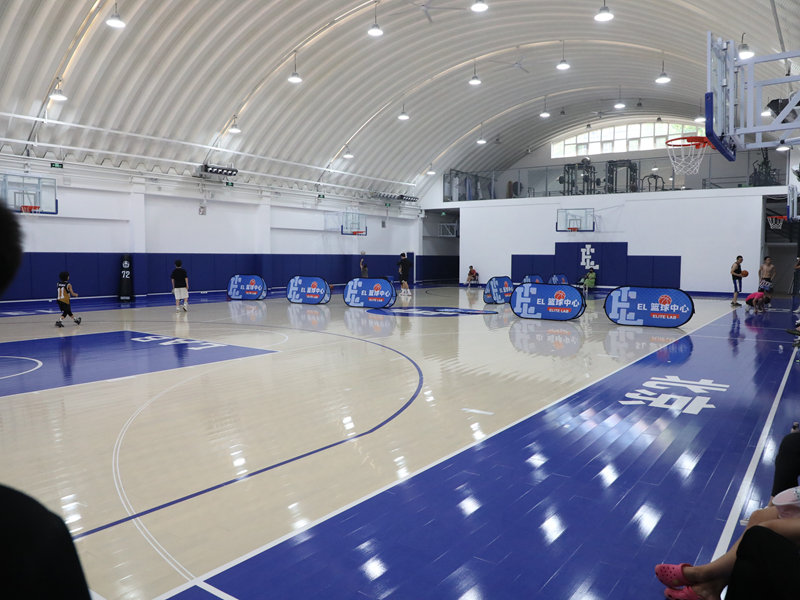
One of the most important decisions in specifying an indoor basketball court floor is choosing between solid hardwood and engineered hardwood. Both have legitimate advantages, and the right choice depends on your specific circumstances.
Solid hardwood is milled from a single piece of lumber. Every plank is one hundred percent hardwood from top to bottom. This construction gives solid hardwood its legendary durability. It can be sanded and refinished repeatedly, with most floors supporting six to ten refinishing cycles over their lifetime. The thickness of solid planks for basketball courts typically ranges from nineteen to twenty-five millimeters, providing excellent shock absorption and structural rigidity.
The downside of solid hardwood is its sensitivity to moisture. Because it is a single piece of wood, solid hardwood expands and contracts more dramatically with changes in humidity. In environments where climate control is inconsistent, solid hardwood can develop gaps, cupping, or crowning. This is why solid hardwood courts are almost always installed over concrete subfloors in climate-controlled gymnasiums.
Engineered hardwood, by contrast, is constructed from multiple layers. The top layer, or veneer, is a thin slice of hardwood, typically two to four millimeters thick. Beneath the veneer are several layers of plywood or high-density fiberboard arranged with alternating grain directions. This cross-grain construction makes engineered hardwood far more dimensionally stable. It resists the expansion and contraction that plagues solid hardwood.
For basketball courts, engineered hardwood has become increasingly popular, especially in regions with extreme humidity or in facilities that do not have precise climate control. The stability advantage can translate into fewer maintenance headaches and a longer-lasting floor in less-than-ideal conditions.
However, engineered hardwood has limitations. Because the veneer is thin, it can only be refinished a limited number of times, typically two to four cycles. Once the veneer is worn through, the floor must be replaced. This means that while engineered hardwood may cost less upfront, its total lifecycle cost can be higher than solid hardwood.
Thickness is another consideration. Engineered planks for basketball courts are typically available up to twenty millimeters, which is adequate for most applications but slightly thinner than the thickest solid options.
If your facility has excellent climate control and you plan to keep the court for decades, solid hardwood is the superior long-term investment. If you face moisture challenges or want a more stable floor with lower upfront cost, engineered hardwood is a smart alternative.
Leave a Reply