

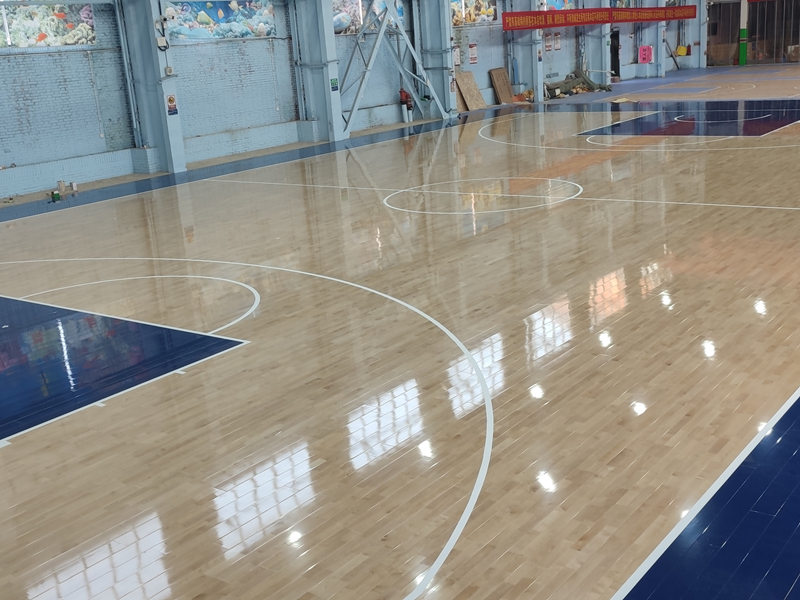
One of the most common questions asked by facility owners and athletic directors is whether they should choose solid hardwood or engineered hardwood for their indoor basketball court. Both options have their merits, and the right choice depends on your specific needs, budget, and facility conditions. This article provides a detailed comparison to help you make the best decision.
Solid hardwood flooring for basketball courts is made from a single piece of wood, typically hard maple, that is milled to a thickness of twenty to twenty-two millimeters. Because it is solid wood throughout, it can be sanded and refinished multiple times over its lifetime — typically five to seven times, depending on the initial thickness. This means a solid hardwood floor can last thirty years or more with proper maintenance. The ability to refinish is one of the biggest advantages of solid hardwood, because it allows you to restore the floor to like-new condition without having to replace it.
In terms of performance, solid hardwood is the gold standard. It provides the most consistent ball bounce, the best feel underfoot, and the most authentic playing experience. Professional and collegiate basketball organizations almost exclusively use solid hardwood for this reason. The density and uniformity of solid maple create a surface that returns energy to the ball in a predictable way, which is critical for players who rely on muscle memory and consistent feedback.
However, solid hardwood also has some disadvantages. It is the most expensive option, both in terms of material cost and installation cost. Because it must be nailed or glued directly to the subfloor, the installation process is more labor-intensive and requires a very flat, stable subfloor. Solid hardwood is also more sensitive to moisture and temperature changes. If the gymnasium's climate control is not precise, the wood can expand, contract, cup, or gap. This is why professional arenas invest heavily in HVAC systems to maintain tight environmental controls.
Engineered hardwood flooring, on the other hand, is made from multiple layers of wood bonded together. The top layer is a hardwood veneer, typically maple, oak, or birch, that is between three and six millimeters thick. The layers beneath are usually made from plywood or high-density fiberboard (HDF), which provide stability and strength. This cross-grain construction makes engineered hardwood much more dimensionally stable than solid hardwood. It is far less likely to warp, cup, or gap when exposed to humidity fluctuations.
Engineered hardwood is typically less expensive than solid hardwood, both in material cost and installation cost. Because it is more stable, it can be installed in environments where climate control is not as precise, making it a good choice for schools, community centers, and multi-purpose facilities. Some engineered systems can even be installed as floating floors, which eliminates the need for nails or glue and speeds up the installation process.
In terms of performance, engineered hardwood with a thick veneer (four millimeters or more) performs very close to solid hardwood. The ball bounce is consistent, the feel is good, and the durability is excellent. However, if the veneer is too thin (less than three millimeters), the floor may not perform as well, and it will have fewer opportunities for refinishing. A thin veneer can only be sanded once or twice before the wood beneath is exposed, at which point the floor must be replaced.
Another consideration is the subfloor requirements. Solid hardwood requires a very flat subfloor with minimal movement, while engineered hardwood is more forgiving. This can save money on subfloor preparation, especially in older buildings where the concrete slab may not be perfectly level.
From an environmental perspective, engineered hardwood is often considered more sustainable because it uses less of the premium hardwood species. The top veneer provides the aesthetic and performance benefits of solid hardwood, while the core layers use faster-growing, less expensive wood species. This means engineered hardwood can achieve a similar look and feel with a smaller environmental footprint.
So which should you choose? If you are building a professional or collegiate-level facility and budget is not a primary concern, solid hardwood is the clear winner. If you are building a high school gym, a community center, or a multi-purpose facility, engineered hardwood with a thick veneer is an excellent choice that offers near-professional performance at a more affordable price. In either case, make sure you work with a reputable supplier and installer who understands the unique requirements of athletic flooring.
Leave a Reply