

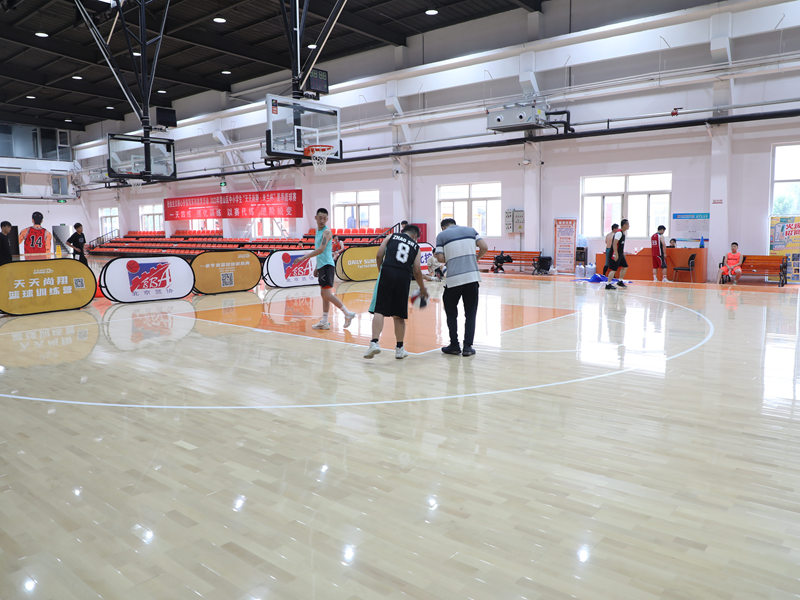
When people think about indoor basketball court flooring, they typically focus on ball bounce and traction. But one of the most important — and most overlooked — functions of the floor is shock absorption. The floor is the first line of defense against the repetitive impact forces that basketball players subject their bodies to every time they jump, land, and change direction. Understanding how hardwood flooring contributes to shock absorption and injury prevention is essential for facility managers, coaches, and players alike.
The Impact Forces in Basketball
Basketball is one of the most physically demanding sports in terms of ground reaction forces. When a player jumps and lands, the force transmitted through the floor and back into the body can reach 3 to 5 times the player's body weight. For a 200-pound player, this means forces of 600 to 1,000 pounds with every landing. Over the course of a game, a player may land hundreds of times, accumulating enormous stress on the joints, particularly the knees, ankles, and lower back.
The surface on which these landings occur plays a direct role in how much of that force is absorbed by the floor versus transmitted to the player's body. A surface that absorbs more force reduces the stress on joints and soft tissues, lowering the risk of overuse injuries and acute injuries.
How Hardwood Absorbs Shock
Hardwood itself is a relatively rigid material, but when installed as part of a complete flooring system — including the subfloor, underlayment, and finish — it provides excellent shock absorption. The system works as a layered cushion:
The top layer is the hardwood and finish, which distributes the impact force across a wide area. The middle layer is the subfloor, which flexes slightly under load, absorbing some of the energy. The bottom layer is the underlayment or cushioning system, which is specifically designed to absorb impact.
The combination of these layers results in a floor that meets or exceeds the shock absorption requirements set by organizations such as the NBA, NCAA, and FIBA. The standard measurement is vertical deformation — the amount the floor compresses under a standard load. For basketball courts, the acceptable range is typically between 2.3 and 5.0 millimeters.
The Injury Prevention Connection
Numerous studies have examined the relationship between court surface and injury rates. The findings consistently show that players on surfaces with adequate shock absorption experience lower rates of joint injuries, particularly knee and ankle injuries. The reduction in impact force translates directly to reduced stress on ligaments, tendons, and cartilage.
One of the most significant injury concerns in basketball is ACL (anterior cruciate ligament) tears. While ACL injuries are caused by a complex combination of factors, the playing surface is one of the modifiable risk factors. Surfaces that provide too much traction can increase the torque on the knee during cutting movements, raising ACL risk. Surfaces that are too hard transmit more force to the joint. Hardwood, with its balanced traction and engineered shock absorption, minimizes both of these risk factors.
The Role of Maintenance in Shock Absorption
Shock absorption is not a static property — it degrades over time as the floor wears. A finish that has worn thin, a subfloor that has deteriorated, or an underlayment that has compressed can all reduce the floor's ability to absorb shock. This is why regular maintenance, including recoating and periodic inspection of the subfloor system, is critical for maintaining injury prevention performance.
The Bottom Line
The shock absorption properties of a hardwood basketball court are not just a comfort feature — they are a safety feature. A properly designed, installed, and maintained hardwood floor reduces the impact forces on players' bodies, lowers injury rates, and extends playing careers. When evaluating a basketball court, shock absorption should be given the same weight as ball bounce and traction.
Leave a Reply