

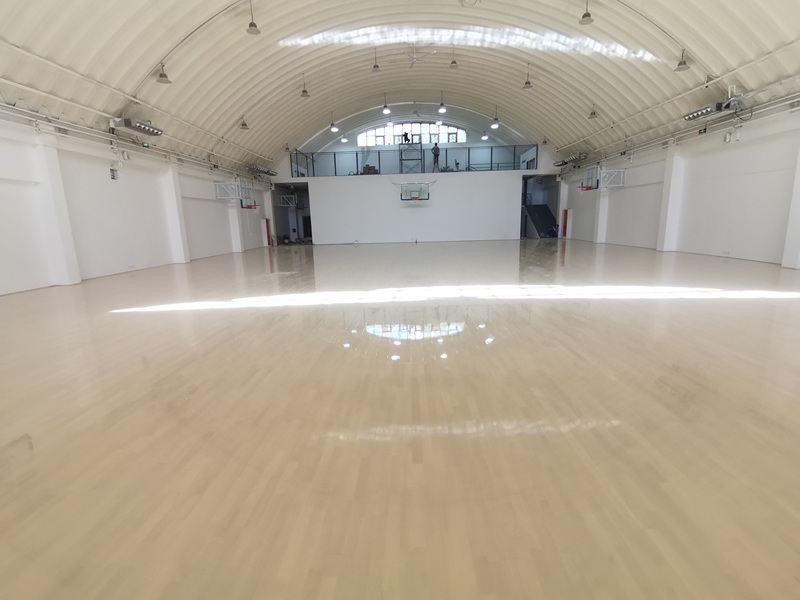
The debate between hardwood and synthetic flooring for indoor basketball courts has been ongoing for decades. Synthetic floors have improved dramatically in recent years, and some now claim performance metrics that rival hardwood. But how do they really compare? This article provides an honest, detailed comparison across every metric that matters.
Ball Bounce: The Deciding Factor
Ball bounce is the single most important performance metric for a basketball court. Players at every level depend on a consistent, predictable bounce to develop their skills and perform at their best.
Hardwood provides a ball bounce with an energy return of 90 to 96 percent. The ball feels "alive" off the floor, returning to the player's hand with minimal energy loss. This consistency is uniform across the entire surface and does not change significantly with temperature or age.
Synthetic floors have improved their energy return to approximately 85 to 92 percent, depending on the product. While this is close to hardwood, it is still measurably lower. More importantly, synthetic floors can exhibit inconsistent bounce patterns. The surface can become "dead" in high-traffic areas while remaining lively in less-used areas, creating an uneven playing experience. Temperature fluctuations can also affect the bounce of synthetic floors more than hardwood.
Traction: Where Synthetic Floors Struggle
Traction is the second most critical factor. Hardwood provides a coefficient of friction that falls within the optimal range for basketball — enough grip to allow quick stops and cuts, but not so much that it stresses the joints.
Many synthetic floors are either too slippery or too sticky. Too slippery, and players are at risk of sliding and injury. Too sticky, and the torque on the knee during lateral movements increases, raising the risk of ACL and meniscus injuries. Hardwood's natural texture, combined with a properly applied finish, consistently delivers the balanced traction that players need.
Shock Absorption: A Surprising Win for Hardwood
Shock absorption is often cited as an advantage of synthetic floors, but the reality is more nuanced. Synthetic floors do absorb more impact than bare hardwood, but when hardwood is installed over a properly engineered subfloor with cushioning, the overall shock absorption is comparable or even superior.
The key difference is in the quality of the shock absorption. Hardwood with cushioning provides a more natural, even distribution of impact forces. Some synthetic floors can feel "mushy" or inconsistent, which can actually increase fatigue and alter a player's movement patterns.
Durability and Lifespan
Hardwood, when properly maintained, lasts 20 to 40 years. Synthetic floors typically last 10 to 15 years before needing replacement. While the initial cost of synthetic flooring is lower, the need for more frequent replacement can make the total cost of ownership comparable to or higher than hardwood over a 30-year period.
Hardwood can also be recoated or refinished multiple times, extending its life even further. Synthetic floors cannot be refinished — when they wear out, they must be replaced entirely.
Aesthetics and Player Experience
This is where hardwood has an insurmountable advantage. The look, feel, and sound of a hardwood court are part of the basketball experience. Players and spectators associate hardwood with the sport itself. Synthetic floors, no matter how advanced, cannot replicate the warmth, the sound of the ball, or the visual appeal of polished maple.
The Verdict
For any facility where performance, player safety, and the basketball experience are priorities, hardwood is the clear winner. Synthetic floors may be appropriate for multi-use facilities where basketball is not the primary sport and budget is the overriding concern. But for dedicated basketball courts, hardwood remains unbeaten.
Leave a Reply