

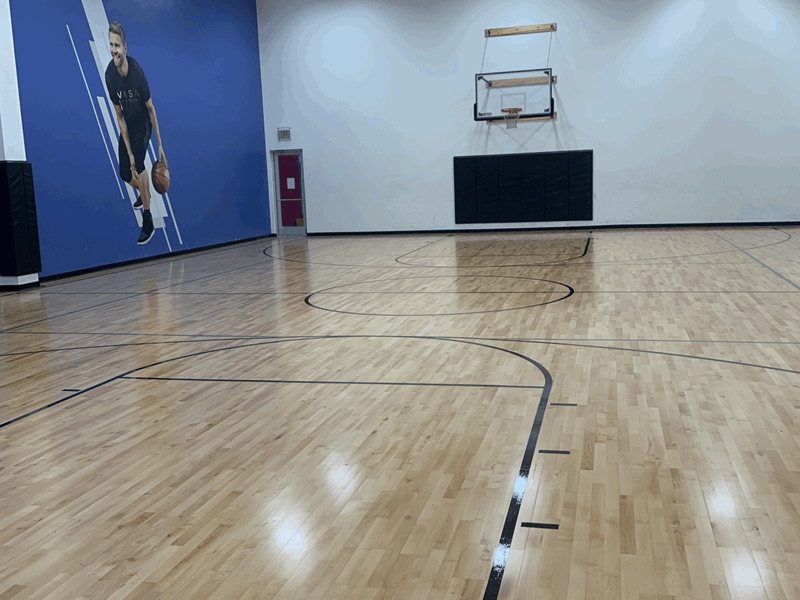
The dimensions of the hardwood planks used on an indoor basketball court are not arbitrary. Every measurement — thickness, width, length, and profile — is chosen based on performance requirements, structural considerations, and industry standards. Understanding these specifications is essential for anyone involved in the design, installation, or maintenance of a basketball court.
Plank Thickness: The Most Critical Dimension
The thickness of hardwood planks for basketball courts is typically 3/4 inch (19 millimeters), though some installations use 7/16-inch or 15/16-inch planks. The 3/4-inch thickness is the industry standard because it provides the optimal balance of structural stability, shock absorption, and durability.
Thinner planks (7/16 inch) are sometimes used in residential settings or in facilities with very strict height restrictions, but they are generally not recommended for basketball courts. Thinner planks are more prone to movement, squeaking, and damage under the heavy loads and constant impact of basketball play.
Thicker planks (15/16 inch) are occasionally used in professional arenas where maximum durability is required. The additional thickness provides more material to sand and refinish over the life of the floor, effectively extending its usable lifespan.
Plank Width: Performance vs. Aesthetics
Plank width is one of the most visible specifications and has both aesthetic and performance implications. The most common widths for basketball courts are 2.25 inches, 3.25 inches, and 4 inches. Wider planks (5 inches or more) are also available but are less common.
Narrower planks (2.25 inches) create more seams, which can trap dirt and require more maintenance. However, they are less expensive and are the standard for most high school and recreational courts.
Wider planks (3.25 to 4 inches) are preferred for professional and college-level courts. They provide a cleaner, more modern appearance with fewer seams, and they tend to be more stable because each plank is wider and less likely to move independently. The trade-off is higher material cost, as wider planks require wider, clearer boards from the log.
Plank Length: Consistency Across the Court
Plank lengths for basketball courts typically range from 2 to 7 feet, with most installations using planks between 3 and 5 feet. The length is chosen to minimize the number of end joints, which are the weakest points in the floor. Fewer end joints mean a more stable, more consistent playing surface.
Random-length installation is standard practice. Planks are installed in a staggered pattern so that no two end joints are aligned, which distributes stress more evenly across the floor.
Tongue and Groove Profile
All basketball court hardwood planks use a tongue-and-groove profile, which allows the planks to interlock and creates a tight, seamless surface. The tongue is the protruding edge on one side of the plank, and the groove is the recessed channel on the other side. When installed, the tongue of one plank fits into the groove of the adjacent plank, creating a secure mechanical bond.
The depth of the tongue and groove varies by manufacturer but is typically between 3/16 and 1/2 inch. A deeper groove provides a stronger bond but requires more precise installation.
Edge Profile: Square Edge vs. Beveled Edge
Most basketball court hardwood uses a square edge profile, where the edges of the planks are cut at a 90-degree angle. This creates a clean, modern look and allows the planks to fit tightly together. Beveled edges, which have a slight angle cut into the edge, are sometimes used for aesthetic purposes but are less common in basketball courts because they create slightly wider gaps that can trap dirt.
Industry Standards and Certifications
All hardwood used for basketball courts should meet the standards set by organizations such as the NWFA, ASTM, and FIBA (for international play). These standards specify minimum hardness, moisture content, finish requirements, and performance criteria including ball bounce, shock absorption, and vertical deformation.
Leave a Reply