

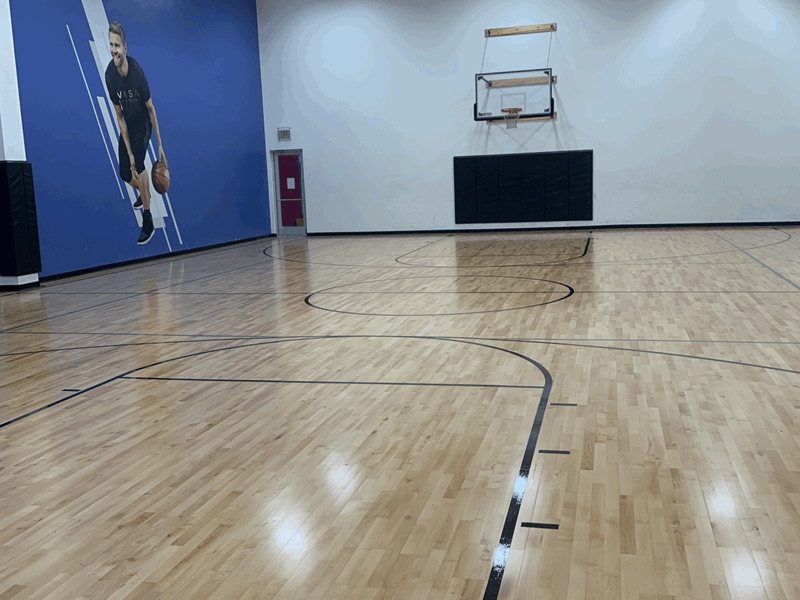
A high-quality indoor basketball court wooden flooring system is not just a nice aesthetic feature for your arena — it is a critical safety infrastructure that directly protects the health and well-being of every athlete that plays on it. There are strict international and national performance standards that define exactly what a safe, high-performance basketball wood floor must deliver, and understanding these standards will help you avoid low-quality, unsafe products that could put players at risk of serious injury.
One of the most important global standards for indoor basketball court wooden flooring is EN 14904, the European standard for sports floor surfaces for indoor multi-sport use. This standard sets out strict, testable requirements for every core performance characteristic of a sports wood floor, including shock absorption, vertical deformation, ball bounce, surface friction, and load resistance. To be certified to EN 14904, a basketball court wooden flooring system must deliver a minimum shock absorption value of at least 53%, meaning it absorbs more than half of the impact force from a falling standard test weight, compared to the impact force that would be experienced on a hard concrete surface. This level of shock absorption is proven to drastically reduce the rate of knee and ankle injuries in basketball players, especially for athletes that play multiple hours every week.
Another key performance requirement defined by global standards is the minimum ball bounce recovery rate of 90%. This means that when a standard official basketball is dropped from a height of 1.8 meters onto the indoor basketball court wooden flooring, it must bounce back up to at least 90% of the height it would bounce on a solid, rigid concrete surface. This requirement ensures that the ball responds consistently and predictably across every part of the court, with no dead spots where the bounce is unexpectedly low, which could cause players to misjudge dribbles, passes, and shots during a competitive game. The standard also requires that the ball bounce performance varies by no more than 10% across different sections of the floor, ensuring complete uniformity of play.
The surface friction of indoor basketball court wooden flooring is another strictly regulated safety parameter, with standards requiring the friction coefficient to stay between 0.4 and 0.7. If the surface is too slippery, with a friction coefficient below 0.4, players will not be able to get proper traction when they make sharp cuts, sudden stops, or change direction quickly, and they will be at very high risk of slipping and falling, leading to sprained ankles, wrist fractures, and head injuries. If the surface is too sticky, with a friction coefficient above 0.7, the soles of basketball shoes will catch on the floor when players try to move, and this can cause severe knee and ankle twists, as the player’s foot cannot move naturally with their body’s momentum. A properly finished and maintained basketball court wooden floor will stay consistently within this safe friction range for years.
National standards, such as the GB/T 20239-2023 standard for gymnasium wooden flooring, add additional requirements for indoor basketball court wooden flooring, including rules for the dimensional stability of the wood panels, the environmental safety of the adhesives and finishes used in the system, and the maximum allowable levels of volatile organic compounds that can be released into the indoor air. These standards ensure that the floor is not only safe for athletic performance, but also non-toxic and healthy for everyone who spends time in the arena. When you are selecting a basketball court wooden flooring system, you should always verify that it meets all of the relevant national and international performance standards, to ensure that you are installing a safe, high-quality product that will protect your players.
Leave a Reply