

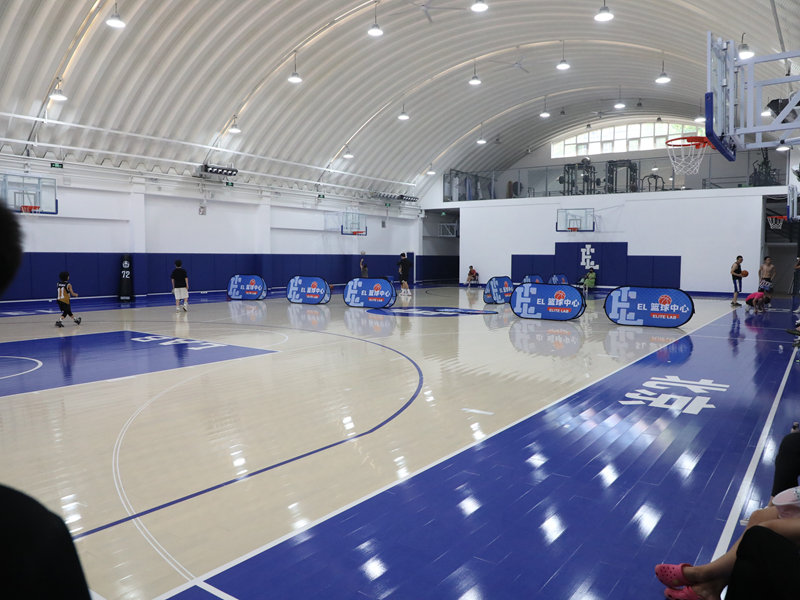
When athletes step onto an indoor basketball court, they expect a certain feel underfoot. The ball should bounce predictably. The surface should be firm but not jarring. The foot should grip without sticking. These expectations are not accidental. They are the result of carefully engineered performance characteristics built into every layer of the flooring system. This article explores what makes a great indoor basketball wood floor perform the way it does.
The most fundamental performance metric is ball bounce consistency. According to governing body standards, when a basketball is dropped from a height of 1.8 meters, it should rebound to a height between 1.2 and 1.4 meters. This range ensures that the game is playable and fair. Achieving this requires the floor to have a specific vertical deformation rate. The wood and the underlayment must compress slightly under impact and then return to their original shape quickly. If the floor is too stiff, the ball bounces too high and the game becomes erratic. If it is too soft, the ball dies on impact and players must exert more energy to dribble and pass.
Shock absorption is the second critical performance factor. This measures how much impact force is reduced when a player lands from a jump. A good indoor basketball floor should provide at least 50 percent shock absorption. This means that if a player generates 100 units of force on landing, the floor reduces the force transmitted to their body to 50 units or less. This is crucial for injury prevention, especially for the knees, ankles, and lower back. The underlayment system is primarily responsible for shock absorption, though the thickness and flexibility of the hardwood also contribute.
The coefficient of friction (COF) determines how much grip the surface provides. A COF that is too low means players slip, especially when they change direction quickly. A COF that is too high means shoes catch on the surface, increasing the risk of ankle injuries. The ideal range for indoor basketball is between 0.4 and 0.6. This range provides enough grip for quick cuts and pivots without creating a sticky surface that strains the joints. The finish on the wood plays a major role in COF. A matte finish typically provides better grip than a high-gloss finish.
Surface hardness is measured using the Brinell or Shore D scale. A properly installed maple floor should have a surface hardness that resists denting from athletic shoes. If the surface is too soft, cleats and hard-soled shoes will leave permanent marks, which not only looks bad but also creates uneven bounce. The Janka hardness of the wood species is the primary determinant, but the finish also adds a protective layer that increases effective hardness.
Flatness and levelness affect every other performance characteristic. A floor that is not perfectly flat will have areas where the ball bounces differently, where players feel unstable, and where the finish wears unevenly. The tolerance for flatness is typically 3 millimeters over 3 meters. This sounds loose, but in practice, even a 2-millimeter deviation can be felt by elite athletes.
Energy return is a more advanced concept that refers to how much of the player's input energy is returned to them. A floor with good energy return feels lively and responsive. Players can jump higher, sprint faster, and change direction more quickly. This is achieved through the combination of a resilient underlayment and a properly tensioned hardwood surface. Professional athletes often describe a good court as feeling alive under their feet, and that sensation is energy return.
All of these characteristics are interrelated. Changing one affects the others. For example, increasing shock absorption by using a thicker underlayment can reduce energy return. Increasing surface hardness by using a thicker finish can reduce the coefficient of friction. The art of sports flooring engineering is finding the optimal balance for the specific use case.
Understanding these performance characteristics helps facility owners make better decisions. It also helps players and coaches appreciate why certain floors feel better than others. It is not magic. It is engineering.
Leave a Reply