

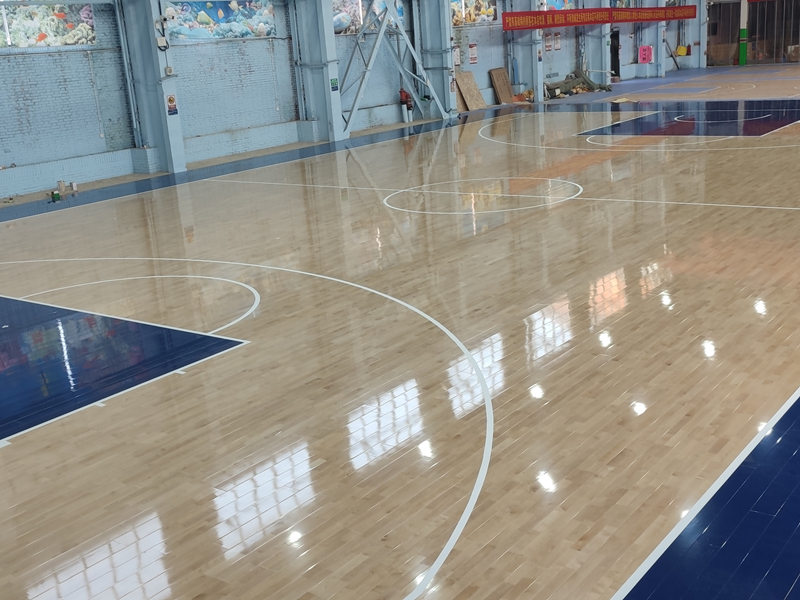
Not all wood is created equal, and when it comes to indoor basketball court flooring, the choice of species can have a dramatic impact on performance, durability, and appearance. While hard maple dominates the market, several other species are used around the world, each with its own strengths and weaknesses. This article provides a detailed comparison of the most common options.
Hard maple, specifically Acer saccharum, is the undisputed king of indoor basketball flooring. Its Janka hardness rating of approximately 1450 makes it one of the hardest domestic woods available. This hardness translates directly into wear resistance. Under the constant pounding of athletic shoes, a maple floor maintains its integrity far longer than softer species. Maple also has a very tight, uniform grain, which means the ball bounce is consistent across the entire surface. There are no soft spots or hard spots that could affect gameplay. The light, creamy color of maple is also highly valued because it creates a clean, professional look that photographs well for broadcast and social media.
European maple, Acer pseudoplatanus, is a close relative of hard maple but with some notable differences. Its Janka rating is slightly lower, around 1300, which means it is somewhat softer. However, it is still hard enough for most basketball applications, and it is often less expensive than North American hard maple. The grain pattern of European maple is slightly more pronounced, which some players find less aesthetically pleasing. For recreational and school-level courts, European maple is a perfectly acceptable and cost-effective choice.
Birch, particularly yellow birch (Betula alleghaniensis), has a Janka rating of about 1260. It is softer than maple but still quite hard. Birch has a similar light color to maple, which makes it a popular aesthetic alternative. However, birch is less dimensionally stable, meaning it expands and contracts more with humidity changes. This can lead to gaps and squeaks over time if the installation is not done perfectly. Birch is more commonly used in Europe and Asia for basketball courts, while North American facilities tend to favor maple.
Oak, both red and white, is significantly harder than maple, with Janka ratings ranging from 1290 to 1360 depending on the variety. However, oak has a very open, pronounced grain pattern that creates visual inconsistency. More importantly, oak does not take finish as evenly as maple, which can result in a patchy appearance after refinishing. Oak is also heavier, which adds structural load to the building. For these reasons, oak is rarely used for basketball courts in North America, though it appears in some European facilities.
Beech is another species worth mentioning. European beech (Fagus sylvatica) has a Janka rating of about 1300 and a very fine, uniform grain. It is widely used for basketball courts in Europe and is known for excellent ball response. However, beech is not as readily available in North America, which limits its use in that market.
When comparing species, the decision usually comes down to three factors: hardness, grain uniformity, and availability. Hard maple wins on all three counts for North American markets. For facilities in other regions, local availability and cost may make birch or beech more practical.
One thing all species have in common is that they must be kiln-dried to a moisture content of 6 to 8 percent before installation. Green or improperly dried wood will move after installation, causing gaps, cupping, and finish failure. Regardless of which species you choose, always verify that the wood has been properly kiln-dried and graded for sports flooring use.
In the end, while alternatives exist, hard maple remains the best all-around choice for indoor basketball court flooring. Its combination of hardness, stability, appearance, and availability makes it the standard against which all other species are measured.
Leave a Reply