

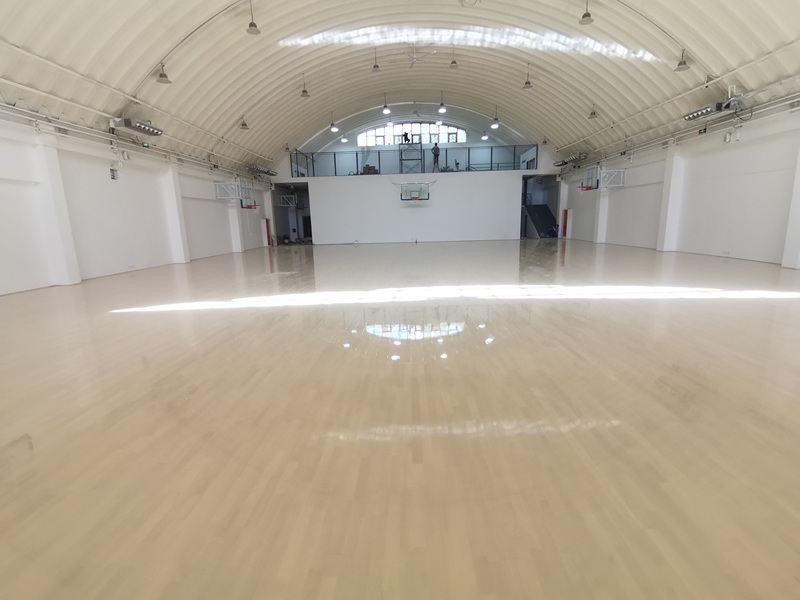
If you are building or renovating a basketball court, it is essential to understand the standards set by the governing bodies of the sport. The NBA (National Basketball Association) and FIBA (International Basketball Federation) have established strict specifications for court flooring to ensure consistency, fairness, and player safety across all levels of play. In this article, we will break down these standards in detail.
NBA Court Floor Standards
The NBA has some of the most stringent flooring standards in the world. Every NBA arena must meet the following specifications:
| Standard | NBA Requirement |
|---|---|
| Ball Bounce | 53-58 inches (1,346-1,473 mm) from a 71-inch drop |
| Shock Absorption | Minimum 53% force reduction (DIN 18032-2) |
| Friction | Coefficient of 0.4-0.6 |
| Surface Flatness | Within 1/16 inch over any 10-foot span |
| Wood Species | Hard maple (Acer saccharum), 3/4 inch thick |
| Finish | Sports-grade polyurethane, semi-gloss |
| Plank Width | 1.75 - 2.25 inches |
| Plank Length | Varies, but typically 6-7 feet |
| Subfloor | Concrete, plywood, or OSB |
| Cushioning | Rubber or foam pads, minimum 3/4 inch thick |
FIBA Court Floor Standards
FIBA, which governs international basketball (including the Olympics), has slightly different but equally rigorous standards:
| Standard | FIBA Requirement |
|---|---|
| Ball Bounce | 1,200-1,400 mm (47-55 inches) from a 1,800 mm drop |
| Shock Absorption | Minimum 35% force reduction (DIN 18032-2) |
| Friction | Coefficient of 0.4-0.6 |
| Surface Flatness | Within 2mm over any 2-meter span |
| Wood Species | Hard maple, beech, or oak |
| Finish | Sports-grade polyurethane |
| Plank Thickness | 20-22 mm (approximately 3/4 inch) |
NCAA (College Basketball) Standards
The NCAA follows standards that are very similar to the NBA, with a few key differences:
| Standard | NCAA Requirement |
|---|---|
| Ball Bounce | 53-58 inches (same as NBA) |
| Shock Absorption | Minimum 53% (same as NBA) |
| Wood Species | Hard maple preferred |
| Finish | Sports-grade polyurethane |
Key Differences Between Standards
| Feature | NBA | FIBA | NCAA |
|---|---|---|---|
| Ball Bounce Height | 53-58" | 47-55" | 53-58" |
| Min. Shock Absorption | 53% | 35% | 53% |
| Allowed Wood Species | Maple only | Maple, beech, oak | Maple preferred |
| Court Size | 94' x 50' | 28m x 15m | 94' x 50' |
Why These Standards Matter
These standards are not arbitrary. They exist to ensure that:
- The game is fair: Every player, regardless of which arena they play in, experiences the same ball bounce and surface conditions.
- Players are safe: The shock absorption requirements protect players from the repetitive impact of running and jumping on a hard surface.
- The experience is consistent: Fans expect the same quality of play whether they are watching in Los Angeles, Madrid, or Beijing.
How to Ensure Compliance
To ensure your court meets these standards:
- Hire a certified installer: Look for installers who are certified by the NBA, FIBA, or NCAA.
- Use approved materials: Use wood, cushioning, and finish that are specifically designed and tested for basketball courts.
- Get independent testing: After installation, have the floor tested by an independent lab to verify compliance with ball bounce, shock absorption, and friction standards.
- Document everything: Keep records of all materials, installation procedures, and test results. This is essential for certification and insurance purposes.
Conclusion
Whether you are building an NBA arena or a local recreation center, understanding and meeting the appropriate flooring standards is essential. By following the NBA, FIBA, or NCAA specifications, you can ensure that your court provides a safe, fair, and world-class playing surface.
Leave a Reply