

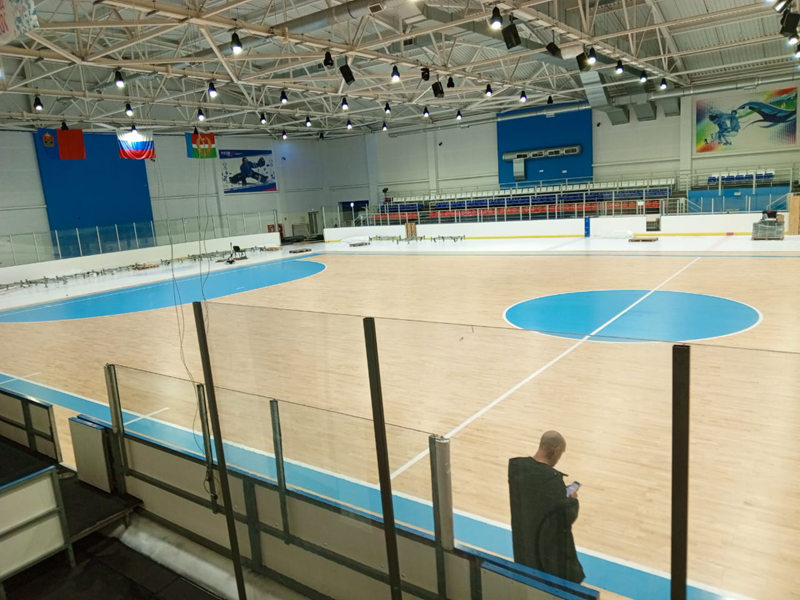
Introduction: The Silent Destroyer
Moisture is the number one enemy of indoor sports wooden flooring. More floors fail due to moisture problems than any other single factor. And the insidious thing about moisture damage is that it often starts invisibly — deep within the subfloor or between panels — before any visible signs appear on the surface.
By the time you see cupping, crowning, gapping, or mold, the damage may already be extensive and expensive to repair. Understanding moisture management — prevention, detection, and remediation — is essential for anyone involved in the design, installation, or maintenance moisture:
- It shrinks
- Gaps between panels widen
- The surface can check (small cracks along the grain)
- Fasteners can loosen as wood pulls away from subfloor
The Critical Moisture Content Range
For indoor sports wooden flooring, the ideal wood moisture content (MC) is 8-12%. This range represents equilibrium with typical indoor conditions (40-60% RH, 20-24°C / 68-75°F).
| Moisture Content | Condition | Risk Level |
|---|---|---|
| 6-8% | Too dry | Moderate (checking, gapping) |
| 8-12% | Ideal | ✅ Low |
| 12-16% | Slightly high | ⚠️ Moderate (swelling risk) |
| 16-20% | High | 🔴 High (cupping, mold risk) |
| >20% | Very high | 🔴🔴 Severe (structural damage) |
Sources of Moisture in Sports Facilities
Understanding where moisture comes from is the first step in preventing it:
- Concrete Subfloor Moisture: New concrete can contain 3-8% moisture by weight. This moisture migrates upward through capillary action, especially if no vapor barrier is installed. Concrete that hasn't cured properly (less than 60 days for standard concrete, 90 days for slab-on-grade) is a major risk.
- Plumbing Leaks: Water supply lines, drain pipes, and fixture connections can leak slowly over months or years. A pinhole leak under a gymnasium floor can go undetected for a long time.
- HVAC Condensation: Air conditioning systems remove moisture from the air. If the supply air temperature is below the dew point of the floor surface, condensation forms on the floor. This is common in humid climates with moisture-resistant tape
- Turn barrier up walls by 100mm minimum (or per local code)
- For wood subfloors: ensure adequate ventilation below (crawl space vents)
Layer 3: Acclimatization
- Store flooring materials in the installation environment for 48-72 hours minimum
- Maintain temperature 18-24°C (65-75°F) and humidity 40-60% during acclimatization
- Stack materials with spacers for air circulation — don't leave wrapped on pallets
Layer 4: Installation Best Practices
- Don't install over wet subfloors — ever
- Use appropriate fasteners that won't corrode (stainless steel or coated)
- Maintain expansion gaps at perimeter and around fixed objects
- Seal penetrations (pipes, columns) with flexible sealant
Layer 5: Operational Controls
- Maintain HVAC to keep indoor RH between 40-60%
- Use dehumidifiers in humid climates or seasons
- Fix leaks immediately — don't wait
- Train custodial staff on proper mopping techniques (mops should be damp, not wet)
- Install moisture sensors in the subfloor (wireless systems available)
Moisture Testing Methods
| Test Method | What It Measures | Standard | Accuracy |
|---|---|---|---|
| Calcium Chloride (CaCl₂) | Moisture vapor emission rate (MVER) | ASTM F1869 | Good for concrete |
| Relative Humidity (RH) Probe | Equilibrium RH in concrete slab | ASTM F2170 | Best method — in-situ |
| Pin-Type Moisture Meter | Wood MC at surface | ASTM D4442 | Quick but surface-only |
| Pinless (Capacitance) Meter | Wood MC to ~6mm depth | ASTM D4442 | Better depth penetration |
| Concrete Moist underside of panels (if accessible) |
- Moisture Mapping: Quarterly measurement of wood MC at multiple points using pinless meters. Track trends over time.
- Subfloor Sensors: Wireless RH/temperature sensors installed in the subfloor during construction. Data logged continuously and alerts sent when thresholds are exceeded.
- Professional Assessment: Annual inspection by a qualified flooring inspector who can:
- Measure MC at multiple depths
- Check subfloor condition (if accessible)
- Evaluate finish condition
- Assess fastener integrity
Remediation: When Prevention Fails
If moisture damage is detected, act quickly. The longer wood stays wet, the more permanent the damage.
Minor Issues (MC 14-18%, slight cupping):
- Improve ventilation and dehumidification
- Allow wood to dry naturally (may take weeks)
- Monitor MC until it returns to 8-12%
- Light sanding may be needed if cupping is severe
Moderate Issues (MC 18-22%, significant cupping/gapping):
- Identify and fix moisture source IMMEDIATELY
- Remove affected panels if possible
- Dry subfloor thoroughly (may require dehumidifiers for weeks)
- Replace damaged panels with properly acclimatized material
- Check and replace vapor barrier if compromised
Severe Issues (MC >22%, mold, structural damage):
- Evacuate the area if mold is present (health hazard)
-,000-14,000**
vs.
- Moisture damage repair (minor): $5,000-15,000
- Moisture damage repair (major): $30,000-100,000+
- Floor replacement due to moisture: $50,000-200,000+
- Facility downtime during repair: $10,000-50,000+ (lost revenue)
Conclusion
Moisture management is not optional — it is the foundation of a successful indoor sports wooden floor. Every dollar spent on prevention saves ten dollars on remediation. Every hour spent on monitoring saves a hundred hours of emergency repair.
Design for moisture control from day one. Test before you install. Monitor continuously. Act immediately when problems arise. And never, ever install wood flooring over a wet subfloor — no matter how much pressure you're under to meet a deadline.
Your floor will thank you. Your budget will thank you. And your athletes will perform better on a dry, stable, well-maintained surface.
Leave a Reply