

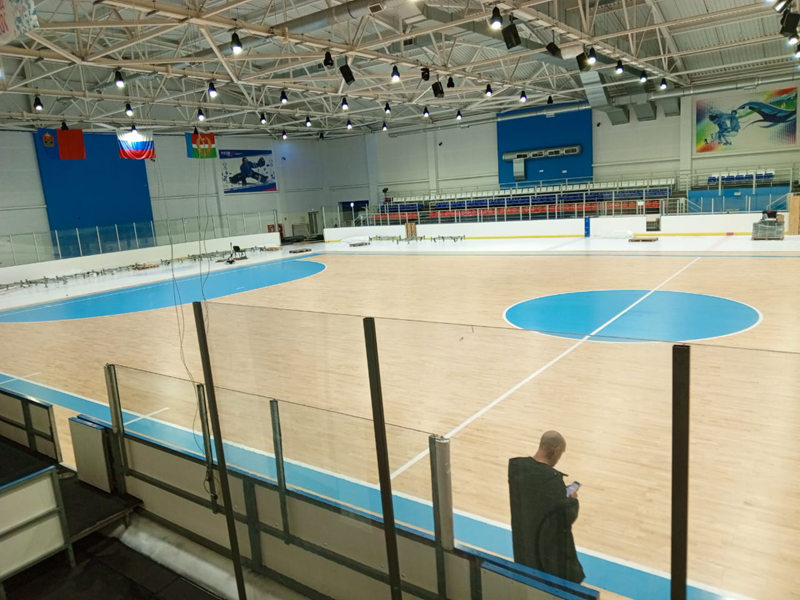
A hardwood basketball court is a significant investment. With proper maintenance, that investment can pay dividends for decades. Without it, the floor can deteriorate rapidly, leading to unsafe playing conditions, expensive repairs, and premature replacement. Maintenance is not optional. It is a core part of owning and operating an indoor basketball facility.
The most fundamental maintenance task is daily cleaning. After every use, the floor should be swept or vacuumed to remove dust, dirt, and debris. These particles act as abrasives. Every time a player runs across them, they scratch the surface of the finish. Over time, this accumulates into visible wear. A microfiber dust mop is the best tool for this job. It picks up fine particles more effectively than a traditional broom.
Mopping should be done regularly, but with a critical caveat: never use excessive water. Hardwood and water do not mix well. Too much moisture can seep into the seams between planks, causing the wood to swell, cup, or warp. The mop should be damp, not wet. A well-wrung mop with a minimal amount of water is all that is needed. Many facility managers use a neutral pH cleaner specifically designed for hardwood floors. Harsh chemicals can strip the finish and damage the wood.
For deeper cleaning, a screen-and-recoat process may be necessary every few years. This involves lightly sanding the entire surface to remove the top layer of worn finish, then applying fresh coats of polyurethane. This restores the floor's appearance and protective qualities. In high-traffic facilities, this may need to happen every two to three years. In lower-traffic recreational facilities, it may only be needed every five to seven years.
Ball bounce testing should be performed periodically. A simple bounce test involves dropping a basketball from a height of 72 inches and measuring the rebound. The ball should bounce between 49 and 54 inches. If the bounce is consistently outside this range, it may indicate that the finish has worn too thin or that the shock absorption layer has degraded.
Grip levels are another important metric. Over time, the finish on a basketball court can become either too slippery or too sticky. A floor that is too slippery increases the risk of players sliding and injuring themselves. A floor that is too sticky can cause players to stick when they try to make quick cuts, also increasing injury risk. The ideal grip level allows players to stop, start, and change direction smoothly without slipping or sticking. If the grip level is off, it can often be corrected by adjusting the finish, rather than replacing the entire floor.
Humidity control is a maintenance issue that is often overlooked. Indoor basketball courts should maintain a relative humidity between 35 and 50 percent. If the humidity gets too high, the wood absorbs moisture and expands. If it gets too low, the wood dries out and shrinks. Both conditions can cause gaps between planks, cupping, or cracking. The HVAC system should be monitored and adjusted as needed to maintain these conditions.
Temperature also matters. The ideal temperature range for an indoor basketball court hardwood floor is between 60 and 75 degrees Fahrenheit. Extreme heat can dry out the wood, while extreme cold can make the finish brittle.
Preventive maintenance is always cheaper than reactive repair. A facility that invests in daily cleaning, regular inspections, and timely recoating will get far more life out of its hardwood floor than one that waits until problems become visible. The key is consistency. Small, regular actions prevent big, expensive problems.
Leave a Reply