

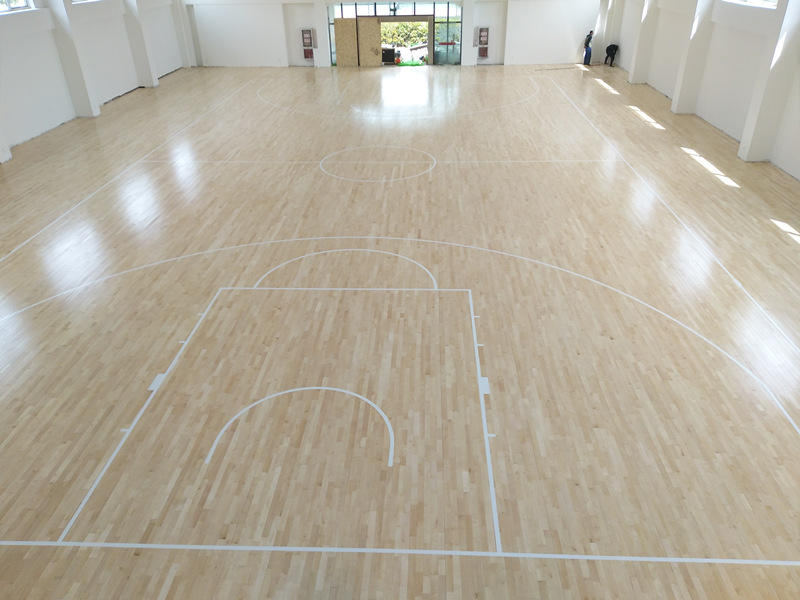
The installation of basketball court wood flooring is a highly specialized process that requires far more than simply nailing planks to a subfloor. A properly installed wood court is a layered system designed to work together to deliver the right combination of stability, shock absorption, and performance, and every step of the installation process has a direct impact on how the floor will perform over decades of use. Even small mistakes during installation can lead to major problems down the line, from uneven play surfaces to premature wear and structural damage.
The first stage of any quality installation is the preparation of the subfloor, which must be completely flat, dry, and structurally sound before any wood material is laid down. Any unevenness in the subfloor will transfer directly to the top wood layer, creating high and low spots that disrupt the smoothness of the playing surface. Installers often use specialized leveling compounds and moisture barriers to ensure that the subfloor meets strict standards, as excess moisture trapped beneath the wood is one of the most common causes of warping and damage to basketball court wood flooring. This preparation work can take several days, but it is the foundation for a long-lasting, high-performance court.
Next comes the installation of the underlayment system, which is the hidden layer between the subfloor and the visible wood planks. This system is engineered to provide the controlled shock absorption that protects players’ joints, while also creating a slight amount of vertical give that makes movement feel more natural and less fatiguing. Different underlayment designs use combinations of resilient pads, adjustable support structures, and air gaps to fine-tune the performance of the entire floor system. The best basketball court wood flooring systems are designed so that this give is consistent across every square foot of the court, ensuring that a player jumping near the baseline experiences exactly the same level of cushioning as a player jumping at the center circle.
Once the underlayment system is fully in place, the wood planks are carefully laid out according to a precise pattern that aligns with the orientation of play on the court. Most professional installations run the planks parallel to the length of the court, which helps to distribute the forces from player movement evenly across the entire floor structure. Each plank is secured using specialized fasteners that are designed to hold the wood firmly in place while still allowing for the small amount of natural expansion and contraction that occurs as humidity levels change. Installers leave carefully calculated gaps along the edges of the court to accommodate this movement, preventing the planks from buckling or pushing against the walls when they expand in more humid conditions.
After all the planks are secured, the entire surface goes through a multi-stage sanding process that flattens every plank to create a perfectly smooth, seamless surface. This sanding must be done with extreme precision, using progressively finer grits to remove all tool marks and create a consistent texture across the entire court. The final step of the installation process is the application of the protective top finish, which seals the wood and creates the final surface that players interact with. When done correctly, this entire installation process results in a basketball court wood flooring system that is not only beautiful to look at but also engineered to withstand thousands of hours of intense competitive play.
Leave a Reply