

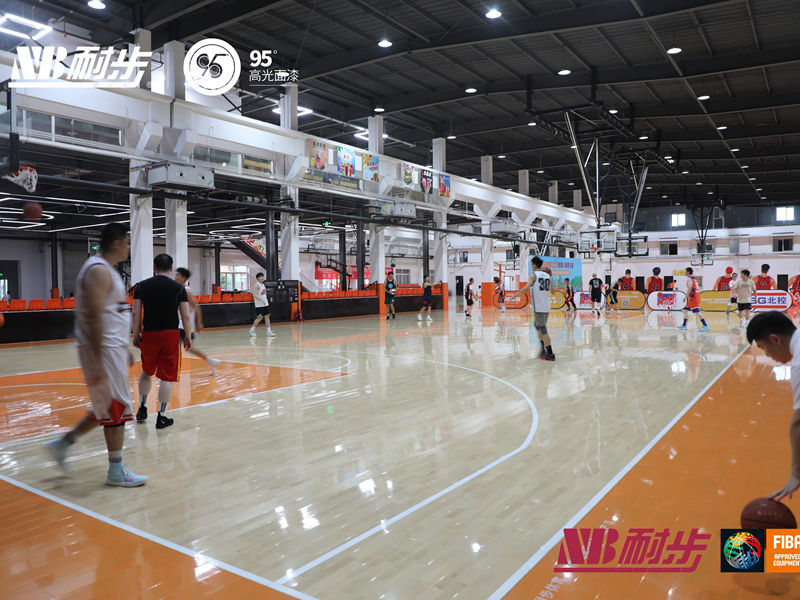
Choosing the right wood material for basketball court wood flooring is a decision that requires a deep understanding of both wood science and the unique physical demands of basketball. Not all wood species are suitable for this application, and the selection process focuses on several key characteristics: hardness, dimensional stability, grain structure, and natural resilience. Each of these properties contributes to how the flooring will perform over years of heavy use, and finding the right balance between them is essential for creating a court that is both durable and athlete-friendly.
Hardness is one of the most frequently considered factors, as it determines how well the wood will resist dents and scratches from the constant impact of basketball shoes, heavy equipment, and frequent foot traffic. A wood that is too soft will quickly develop visible marks and indentations that can disrupt the smoothness of the playing surface, while a wood that is overly hard will not provide enough give to absorb impact forces, leading to increased stress on players’ joints. The ideal materials for basketball court wood flooring fall in a specific middle range of hardness, firm enough to maintain a smooth, even surface over thousands of hours of play, but yielding just enough to cushion each step and jump.
Dimensional stability is another critical property, as indoor sports environments often experience fluctuations in temperature and humidity that can cause wood to expand or contract. If the wood planks are not dimensionally stable, they can warp, cup, or create gaps between boards as environmental conditions change. This not only ruins the smooth appearance of the court but also creates safety hazards that can cause players to trip or lose their footing. High-quality basketball court wood flooring materials are selected for their ability to resist these dimensional changes, maintaining a flat, uniform surface even when indoor climate conditions shift significantly over the course of a year.
The grain structure of the wood also plays a major role in performance. A tight, consistent grain pattern helps to create a uniform surface texture that supports even friction across the entire court. Wood with irregular or highly variable grain can create subtle differences in surface texture from one plank to the next, leading to inconsistent traction that can throw off an athlete’s movements. The natural resilience of the wood, which refers to its ability to deform slightly under impact and then spring back to its original shape, is what gives well-built basketball court wood flooring its characteristic "bounce" that players can feel under their feet. This resilience is a natural property of the wood itself, and it cannot be fully replicated by adding layers of synthetic cushioning on top of a harder base material.
Finally, the natural appearance of the wood is an important consideration that ties into the overall aesthetic of the space. The subtle variations in color and grain that are unique to natural wood give each basketball court its own distinct character, rather than the uniform, mass-produced look of synthetic surfaces. This natural beauty does not come at the cost of performance, however, as the best materials are chosen to balance visual appeal with every functional requirement of competitive basketball play.
Leave a Reply