

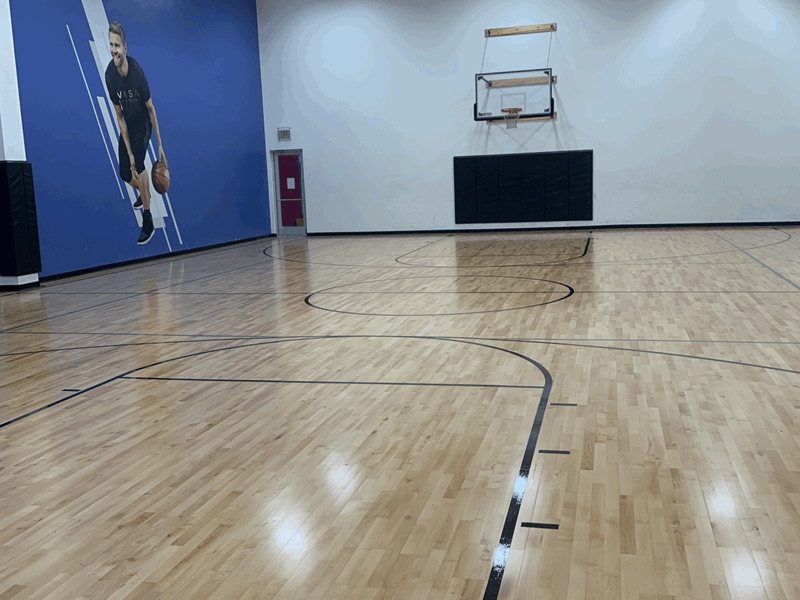
When planning an indoor basketball court, one of the first decisions you will face is what type of flooring to install. While wooden flooring is the traditional and most popular choice, there are several alternative options available, each with its own set of advantages and disadvantages. This article compares wooden flooring with the most common alternatives to help you make an informed decision.
Synthetic sports flooring, often made from polyvinyl chloride (PVC) or polypropylene, is the primary alternative to wood. These floors are made from rolls or tiles of synthetic material that are installed over a subfloor. They are available in a wide range of colors and patterns, and they can be customized with court lines, logos, and other graphics.
One of the biggest advantages of synthetic flooring is its consistency. Unlike wood, which can vary in appearance from plank to plank, synthetic flooring is uniform across the entire surface. This can be appealing for facilities that want a very clean, modern look. Synthetic floors are also generally less expensive than wood, both in material cost and installation cost. They are easier to clean, require less maintenance, and are not affected by humidity or temperature changes.
However, synthetic flooring has some significant drawbacks when it comes to basketball. The ball bounce on synthetic floors is generally less consistent than on wood. The surface can feel harder and less forgiving, which increases the risk of injury to players' joints. Synthetic floors also do not have the same "feel" as wood — many players describe the experience as plasticky or artificial. For competitive play, wood is almost always preferred.
Another alternative is poured polyurethane flooring, which is a seamless, cushioned surface that is poured in place like concrete. This type of flooring is sometimes used in multi-purpose facilities because it can be colored and textured in many different ways. It provides good shock absorption and is very durable. However, like synthetic flooring, it does not offer the same ball bounce consistency or playing feel as wood. It is also more difficult to repair if damaged, as patches can be visible.
Concrete floors with a painted surface are the most budget-friendly option, but they are by far the worst choice for basketball. Concrete is extremely hard, which puts tremendous stress on players' joints. The ball bounce on concrete is inconsistent and unpredictable, and the surface offers no shock absorption whatsoever. Concrete floors are only suitable for very casual, recreational play where performance and safety are not primary concerns.
Rubber flooring is another option that is sometimes used in gymnasiums. Rubber tiles or rolls can be installed over a subfloor to provide a cushioned, non-slip surface. Rubber flooring is durable, easy to clean, and provides good shock absorption. However, it does not offer the same ball bounce characteristics as wood, and it can feel too soft or bouncy for serious basketball play. Rubber is better suited for weight rooms, exercise areas, or multi-purpose courts where basketball is only one of several activities.
Carpet tiles are occasionally used in elementary school gyms or community centers where budget is extremely limited. Carpet provides excellent shock absorption and is very quiet, but it is a terrible choice for basketball. The ball does not bounce properly on carpet, and players' shoes do not grip the surface well, increasing the risk of slips and falls. Carpet also traps dirt and moisture, making it difficult to keep clean.
When you compare all of these options, wood remains the clear winner for any facility where basketball is the primary sport. The combination of consistent ball bounce, superior shock absorption, authentic feel, and long lifespan makes wood the best investment for serious basketball programs. Synthetic and other alternatives may make sense for multi-purpose facilities or very budget-constrained projects, but they should never be considered a true substitute for wood when basketball performance is the priority.
Leave a Reply