

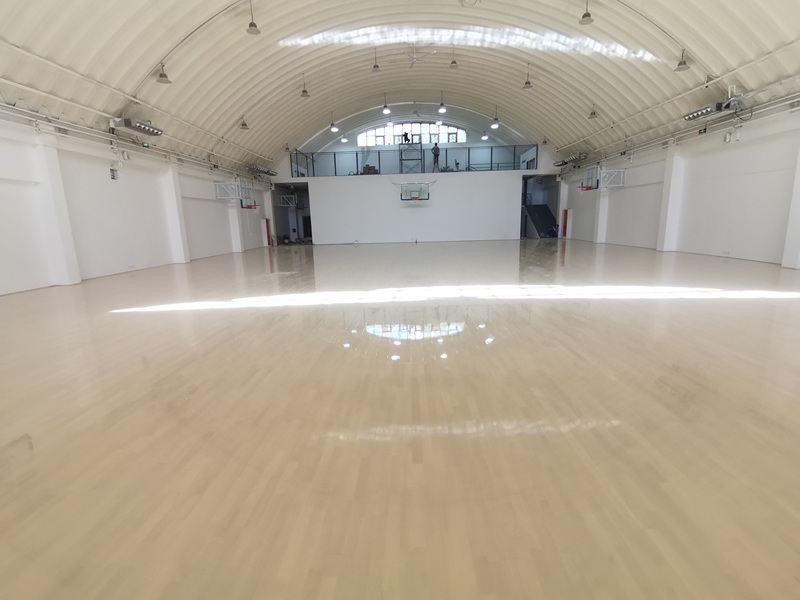
When planning an indoor basketball facility, one of the biggest decisions is choosing the flooring surface. Hardwood is the traditional and most popular choice, but it is not the only option. Synthetic surfaces, rubber flooring, and even carpet tiles are used in some facilities. Each has advantages and disadvantages.
Hardwood subfloor is arguably the most important component of the entire system. The subfloor is the foundation upon which everything else is built, and if it fails, the entire floor fails.
The subfloor serves several critical functions. First, it provides a flat, stable surface for the hardwood to be installed on. Any irregularity in the subfloor will be transmitted through the hardwood, creating waves, humps, or gaps in the playing surface. Second, it distributes the load from the players across a wider area, reducing point loads on the concrete slab below. Third, it provides a nailing or fastening surface for the shock absorption system and other components. Fourth, it acts as a moisture barrier, protecting the hardwood from moisture rising from the concrete below.
The most common subfloor material for indoor basketball courts is plywood, typically three-quarter inch or seven-eighths inch thick. Plywood is strong, dimensionally stable, and relatively inexpensive. It is available in large sheets, which minimizes the number of seams. The seams must be staggered and secured properly to prevent movement.
Oriented strand board, or OSB, is another option. It is less expensive than plywood but is more susceptible to moisture and less dimensionally stable. For basketball courts, plywood is generally preferred over OSB.
Concrete is the base layer beneath the subfloor. The concrete slab must be level, clean, and dry. Any cracks in the concrete must be repaired before the subfloor is installed. A moisture test should be performed on the concrete to ensure that moisture levels are within acceptable limits. If the moisture content is too high, a moisture barrier must be installed between the concrete and the subfloor.
to show off the natural color of the wood, some facilities add a slight tint. Amber tints are popular because they enhance the warm tone of maple and reduce glare even further.
Regardless of the finish type, proper application is critical. A poorly applied finish, with drips, bubbles, or uneven thickness, will perform poorly and look bad. Only experienced finish applicators should work on a basketball court floor.
Leave a Reply