

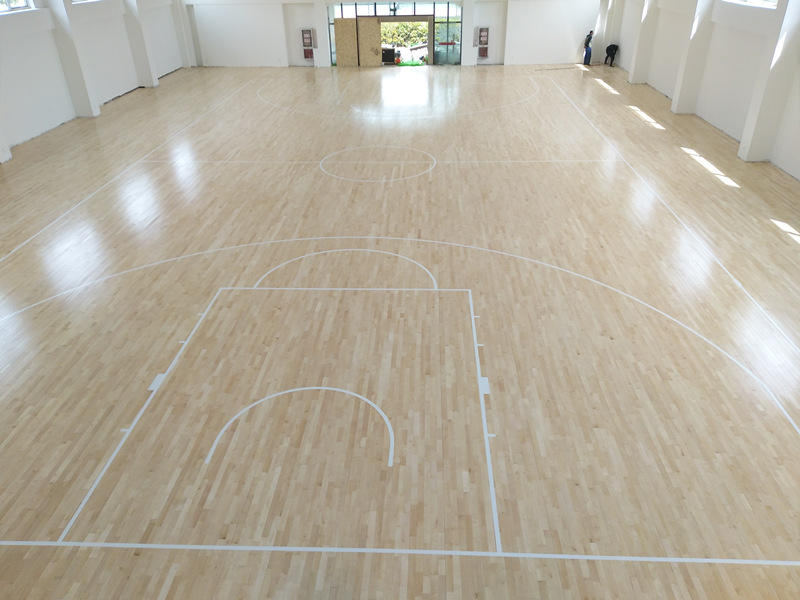
Installing portable basketball court wood flooring is a process that rewards careful planning and methodical execution. While the system is designed to be user-friendly, cutting corners during installation will compromise performance and shorten the life of your floor. This step-by-step guide covers everything from site preparation to final inspection.
Step one is site preparation, and this is where most installation problems originate. The subfloor must be completely level, clean, and dry. For indoor installations, this typically means a concrete slab or a properly finished plywood subfloor. For outdoor installations, you may need to lay down a base layer of compacted gravel or interlocking plastic tiles to ensure drainage and levelness. Use a long straightedge and a level to check for deviations. Any gap or bump greater than three millimeters across a two-meter span must be addressed before proceeding.
Step two is acclimatization. Wood is a natural material that expands and contracts with changes in temperature and humidity. Before installation, store the flooring panels in the installation environment for at least 48 hours. This allows the wood to reach moisture equilibrium with the surrounding air. Skipping this step is one of the most common mistakes and can lead to gaps, buckling, or warping after installation.
Step three is laying out the panels. Start from one corner of the court and work systematically across the space. Most portable systems use a staggered joint pattern, similar to how bricklayers lay bricks. This distributes stress evenly and creates a more stable surface. Leave an expansion gap of approximately eight to ten millimeters around the entire perimeter of the court. This gap will be covered by baseboard trim or rubber edging later.
Step four is connecting the panels. Depending on the system, this may involve sliding tongue-and-groove edges together, snapping interlocking clips into place, or applying adhesive strips. Apply even pressure across the entire joint to ensure a tight fit. Use a rubber mallet to gently tap panels into place if needed, but never use a metal hammer directly on the wood surface.
Step five is securing the floor. While many portable systems rely on the weight of the panels and the friction of the connections to stay in place, some installations benefit from additional securing. This can include perimeter clips, corner brackets, or adhesive strips along the edges. Check the manufacturer's recommendations for your specific system.
Step six is finishing. Install the perimeter trim to cover expansion gaps. Apply any recommended surface treatments, such as anti-slip coatings or line-painting preparation. If the floor will be used for official games, make sure the surface meets the required friction and bounce standards.
Step seven is the final inspection. Walk the entire court and check for any loose panels, uneven joints, or surface defects. Bounce a basketball in multiple locations to verify consistent ball response. Look for any squeaking or movement when applying pressure to individual panels.
A well-installed portable basketball court wood floor should feel solid, level, and responsive from the first day. With proper care, it will continue to perform at a high level for years.
Leave a Reply