

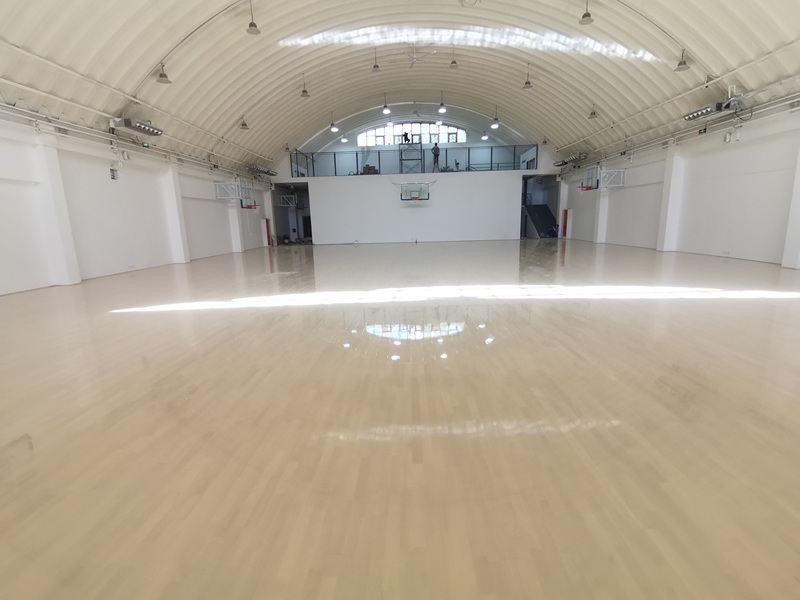
The surface a player competes on has a direct and measurable impact on performance. While skill and athleticism are the primary determinants of success, the floor can either enhance or hinder a player's ability to perform at their best.
Traction is the most obvious factor. Basketball is a sport of sudden stops, explosive starts, and rapid directional changes. The friction between a player's shoe and the floor determines how effectively they can generate force. Hardwood with a quality finish provides a coefficient of friction that is high enough to prevent slipping but low enough to allow controlled sliding. This balance is essential for both offensive drives and defensive movements.
Ball response is another critical element. The way the ball bounces off the floor affects shooting accuracy, passing precision, and dribbling control. Hardwood provides a consistent, predictable bounce that players can rely on. The uniformity of the surface means that the ball behaves the same way regardless of where on the court it lands. Alternative surfaces like rubber can produce a deader bounce, while some synthetic surfaces can create unpredictable variations.
Energy return refers to how much of a player's effort is returned to them by the floor. A floor with good energy return reduces fatigue and allows players to maintain their intensity throughout a game. Hardwood, particularly when installed over a resilient system, offers excellent energy return. Players report feeling less tired on hardwood courts compared to surfaces that absorb too much energy.
Joint stress is a performance factor that often goes unmentioned. A floor that is too hard increases the impact forces transmitted through the legs, leading to faster fatigue and a higher risk of overuse injuries. A floor that is too soft forces muscles to work harder to stabilize the body, also increasing fatigue. Hardwood strikes the optimal balance, minimizing joint stress while maintaining the responsiveness that elite players demand.
Acoustics also play a role. The sound of the ball, the squeak of shoes, and the echo in the gym all contribute to a player's spatial awareness. Hardwood courts have a distinctive acoustic profile that experienced players find intuitive and helpful.
For any serious basketball program, the floor is not just a surface. It is a performance tool.
Leave a Reply