

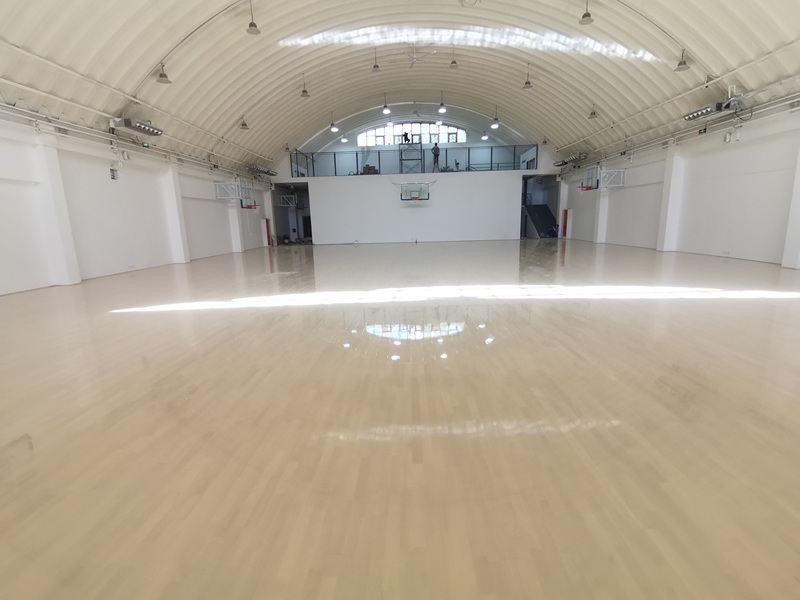
One of the most common questions facility managers ask is: "Can I use the same wooden floor for multiple sports?" The short answer is: yes, but with important caveats.
Different sports have different performance requirements, and a floor optimized for basketball may not be ideal for volleyball or badminton. In this article, we'll explore the specific flooring needs of various indoor sports and how to design a multi-sport gymnasium floor that works for everyone.
Basketball: The Gold Standard
Basketball is the most demanding sport for gymnasium flooring, and it sets the baseline for most floor specifications.
Key Requirements:
- Shock absorption: 35-50% (NBA standard is 53% for K3 classification)
- Ball bounce: 90-100% (ball dropped from 72" should bounce to 49-54")
- Surface friction: 0.4-0.6 coefficient of friction
- Surface evenness: ±1/8" per shock pad
- UV-cured or high-performance polyurethane finish
- Typically installed with planks running parallel to the sideline (for aesthetic reasons) or parallel to the baseline (for performance consistency)
Volleyball: The Gentle Giant
Volleyball seems less demanding than basketball—no jumping, no running, no sliding. But it has its own unique requirements.
Key Requirements:
- Shock absorption: 35-45% (slightly less than basketball because impacts are lower)
- Ball bounce: 90%+ (volleyball should bounce consistently)
- Surface friction: 0.5-0.7 (higher than basketball—volleyball players need more grip)
- Surface evenness: ±1/8" per 10 feet (same as basketball)
Why different from basketball?
Volleyball players don't jump as high or as often, so shock absorption can be slightly lower. However, they move laterally constantly—digging, setting, spiking—and need more surface friction to prevent slipping. The higher friction also helps with the "platform" feel that volleyball players prefer.
Floor Design:
- 3/4" solid maple (same as basketball)
- Slightly firmer shock pad (3/8" rather than 1/2") to provide more stability
- Matte or satin finish (glossy finishes are too slippery for volleyball)
Special Consideration:
The area under the net is critical for volleyball. Players dive and slide in this zone,ness**: ±1/16" per 10 feet (more strict than basketball!)
Why stricter evenness?
Badminton involves extremely rapid footwork over a small area. Any bump or ridge that a basketball player wouldn't notice can cause a badminton player to twist an ankle. The shuttlecock also skims very close to the floor, so surface imperfections can affect play.
Floor Design:
- 3/4" solid maple
- 3/8" shock pad
- Flat/matte finish (glossy finishes reflect light and can be distracting)
- Many facilities use PVC sports mats over the wood for badminton courts—this provides a slightly different surface that's preferred by serious players
Gymnastics: The Extreme Case
Gymnastics is perhaps the most demanding sport for flooring because of the extreme forces involved.
Key Requirements:
- Shock absorption: 45-55%+ (much higher than other sports)
- Ball bounce: Not relevant
- Surface friction: 0.5-0.6
- Surface evenness: ±1/16" per 10 feet
- Thickness: Often 1-1.5" total system (thicker than basketball)
Why so different?
Gymnasts land from heights of 6-10 feet, generating impact forces of 10-15 times body weight. A 120-pound gymnast landing from a 10-foot tumble generates over 1,500 pounds of force. The floor must absorb Many gymnastics facilities use a spring floor (like the AAI Sprung Floor) rather than a traditional wood floor. These are purpose-built systems that combine wood surfaces with mechanical spring systems underneath.
Multi-Sport Facility Design: The Compromise
Most school and community gymnasiums need to accommodate 2-4 sports. Here's how to design a floor that works for all of them:
The Universal Basketball Floor
The best multi-sport floor is optimized for basketball, since basketball has the most demanding requirements. If the floor meets basketball specs, it will automatically meet the requirements for volleyball, badminton, and most other sports.
Target Specifications for Multi-Sport:
- Shock absorption: 40-50%
- Ball bounce: 90-95%
- Surface friction: 0.4-0.6
- Evenness: ±1/8" per 10 feet
- Wood: 3/4" maple, 2.25" wide planks
- Shock pad: 3/8" SBR rubber
- Finish: UV-cured or high-performance polyurethane, satin sheen
Sport-Specific Adjustments:
- For volleyball: Add a 1/4" thick rubber mat in the front-court area for extra cushioning
- For badminton: Lay PVC mats over the wood in the badminton zone
- For gymnastics: Install a separate spring floor system in the gymnastics area (don't try to make one floor do everything)
Court Marking Considerations:
Multi-sport floors need multiple
Leave a Reply