

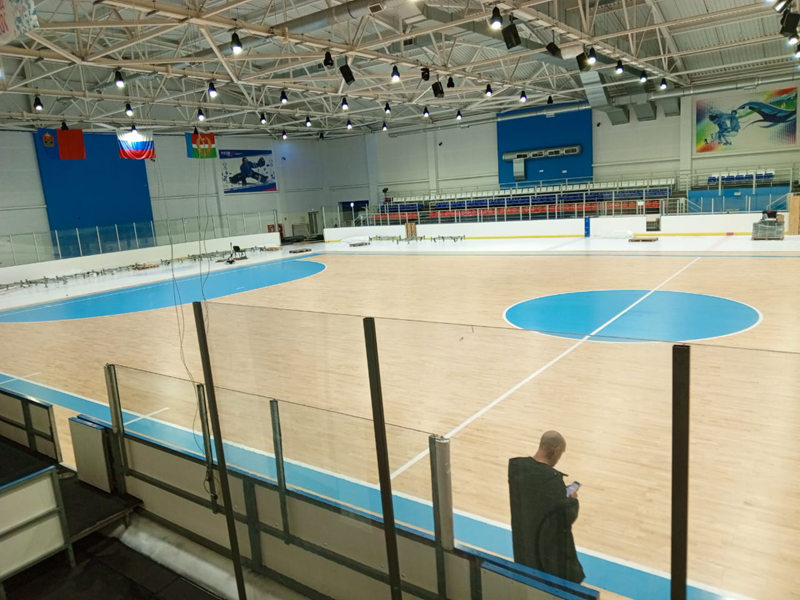
For high-level professional basketball competition venues that host official matches and elite athlete training, the single-layer keel modular flooring system is not sufficient to meet the strict international performance standards set by global sports governing bodies. These top-tier venues use a double-layer cross keel system, which delivers far superior vibration absorption and deformation resistance compared to simpler single-layer designs. In this system, the first layer of main keels is secured directly over the rubber shock pads on the subfloor, spaced 600 millimeters apart. The second layer of auxiliary keels is then laid perpendicular across the top of the main keels, spaced 400 millimeters apart, creating a dense, interlocking grid that distributes impact force across a far wider area of the floor.
This double cross-keel structure creates a "floating" effect for the entire playing surface, meaning that when a player lands heavily in one spot, the impact force is spread out across dozens of adjacent keel joints, rather than being concentrated on a single point. This design ensures that the maximum vertical deformation of the floor under a 2000-newton impact force stays between 2 millimeters and 5 millimeters, the exact range that provides enough give to cushion joints without being so soft that it makes players feel unsteady on their feet. The shock absorption rate of a properly installed double-keel system can reach 50%, meaning half of the force from every jump landing is absorbed by the floor structure, rather than being transmitted directly through the player’s legs to their knees and spine. This level of performance is non-negotiable for professional venues, as it allows elite athletes to train and compete for hours every day without suffering the chronic joint injuries that are common on hard concrete or poorly designed floors.
The double-keel system also delivers far more consistent ball bounce across the entire court. On a single-keel floor, there can be small variations in bounce height between the spots directly over a keel and the spots between two keels, which can subtly interfere with a player’s dribble rhythm and shooting touch. The dense cross grid of the double-keel system eliminates this variation entirely, ensuring that a standard basketball dropped from 1.8 meters will bounce back to at least 90% of its cement-floor bounce height at every single point on the 28-meter by 15-meter court. This level of consistency is what allows professional players to trust the floor completely, so they can focus entirely on their performance rather than adjusting their movements to compensate for uneven surface response.
Leave a Reply