

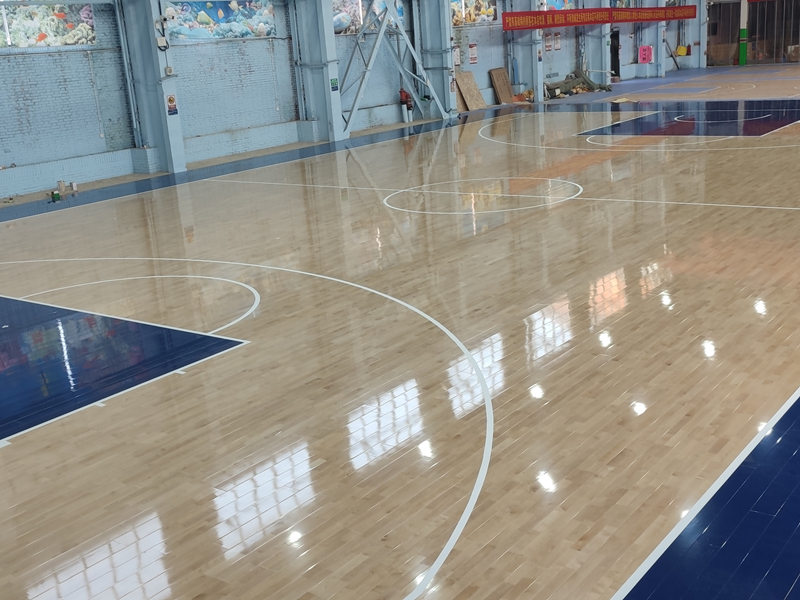
Modular indoor basketball court wood flooring is a natural material system that is highly sensitive to changes in ambient temperature and humidity, and without proper design and adaptation measures, it will inevitably develop problems like warping, cracking, gap formation, or surface buckling over time. The most critical design feature to prevent these issues is the reserved expansion gap system. Around the entire perimeter of the court, where the floor meets the surrounding walls, a 20-millimeter wide gap is left between the edge of the hardwood planks and the wall. This gap is completely hidden by the specially designed vented skirting board, so it does not affect the appearance of the court, but it gives every plank in the entire floor system enough space to expand outward when the indoor humidity rises in summer, so the planks will not push against each other and buckle upward in the middle of the court.
Every plank in the modular system is precision milled with a controlled tongue-and-groove joint that leaves a tiny, consistent micro-gap between adjacent planks even when they are fully locked together. This micro-gap is calculated based on the local annual humidity variation range, so when the wood absorbs moisture and swells, the small gaps between planks close up gently, rather than creating internal stress that causes the planks to warp. For venues located in regions with extremely large seasonal humidity changes, specialized humidity-stabilized wood is used, which has undergone a secondary high-temperature treatment process that modifies the internal wood fiber structure, reducing the wood’s natural moisture absorption rate by more than 40%. This treatment makes the planks far less responsive to sudden spikes or drops in air humidity, drastically reducing the risk of seasonal deformation.
The keel system also incorporates small, adjustable rubber leveling pads that can compensate for minor seasonal shifts in the subfloor’s shape. These pads are made of a high-durability rubber compound that maintains its elasticity for more than 20 years, so the floor will not develop low spots or squeaky joints as the building structure settles over time. To further enhance long-term stability, the entire modular system is designed with hidden air circulation channels running along the length of the keels. These channels connect to the vented skirting boards around the perimeter of the court, creating a slow, continuous flow of fresh air under the floor that prevents stagnant, moist air from being trapped against the bottom of the hardwood planks. This hidden ventilation system eliminates the damp, enclosed environment that would otherwise allow mold to grow on the back of the planks, ensuring the wood stays dry and stable for decades of use.
Leave a Reply