

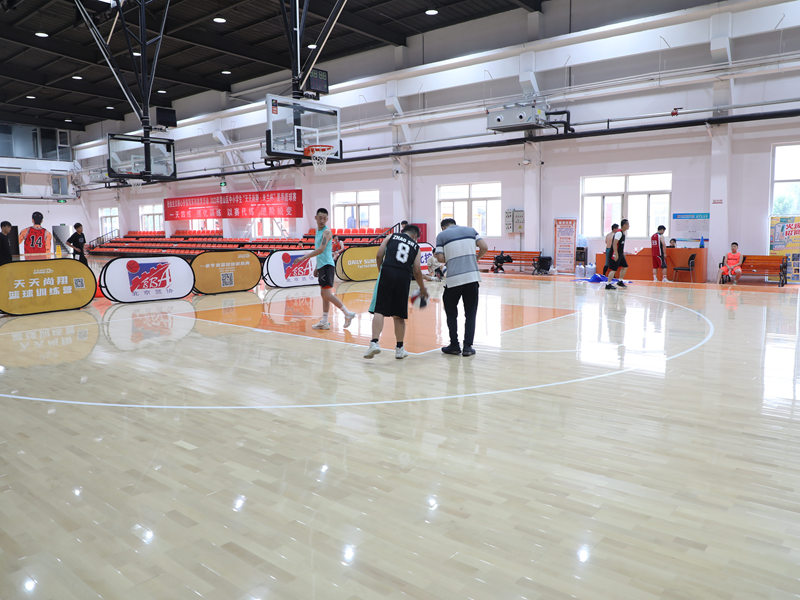
The wood species used for the top layer of a demountable sports wood floor has a direct impact on performance, appearance, and cost. While there are several options available, hard maple is by far the most popular choice for basketball courts. However, oak and ash also have their place in certain applications. Understanding the characteristics of each species helps you make an informed decision.
Hard maple, specifically sugar maple (Acer saccharum) and rock maple (Acer saccharum var. nigrum), is the industry standard for basketball court floors. It has a Janka hardness rating of approximately 1,450 pounds, which makes it extremely resistant to dents and scratches. The wood is also very uniform in color and grain, which gives the finished court a clean, professional appearance. Maple provides an excellent ball bounce and a consistent surface friction that players love.
One of the reasons maple is so dominant in basketball is its density. Dense wood provides a firmer playing surface, which translates to better ball response and more predictable bounce. This is critical in a sport where fractions of a second matter. Maple also takes finish very well, resulting in a smooth, consistent surface that is easy to maintain.
Red oak (Quercus rubra) is the second most common species used for sports floors. It has a Janka hardness of about 1,290 pounds, which is slightly softer than maple but still very durable. Oak has a more pronounced grain pattern, which gives it a distinctive appearance. Some facilities prefer the look of oak, especially in gyms where aesthetics are a priority. However, oak is slightly less dense than maple, which means the ball bounce may be marginally lower.
White oak (Quercus alba) is similar to red oak but has a tighter grain and is slightly more water-resistant. It is sometimes used in areas where moisture control is a concern, though it is less common than red oak for basketball courts.
Ash (Fraxinus americana) is another option, though it is used less frequently for basketball. Ash has a Janka hardness of about 1,320 pounds and a very light, almost white color. It provides good shock absorption due to its slightly lower density, but it is not as hard-wearing as maple. Ash is more commonly used for volleyball and multi-sport courts where a softer feel is preferred.
When choosing a wood species for a demountable system, it is important to consider not just performance but also the demountable connector compatibility. Some connector systems are designed specifically for maple and may not work as well with other species. Always check with the floor system manufacturer to ensure compatibility.
Cost-wise, maple is typically the most expensive option, followed by oak, with ash being the most affordable. However, the price difference is usually not dramatic, and the performance benefits of maple generally justify the extra cost for dedicated basketball courts.
In the end, for a dedicated indoor basketball court, hard maple is the clear winner. It offers the best combination of hardness, ball response, durability, and appearance. If budget is a major constraint and the court will be used for multiple sports, oak or ash may be a reasonable alternative.
Leave a Reply