

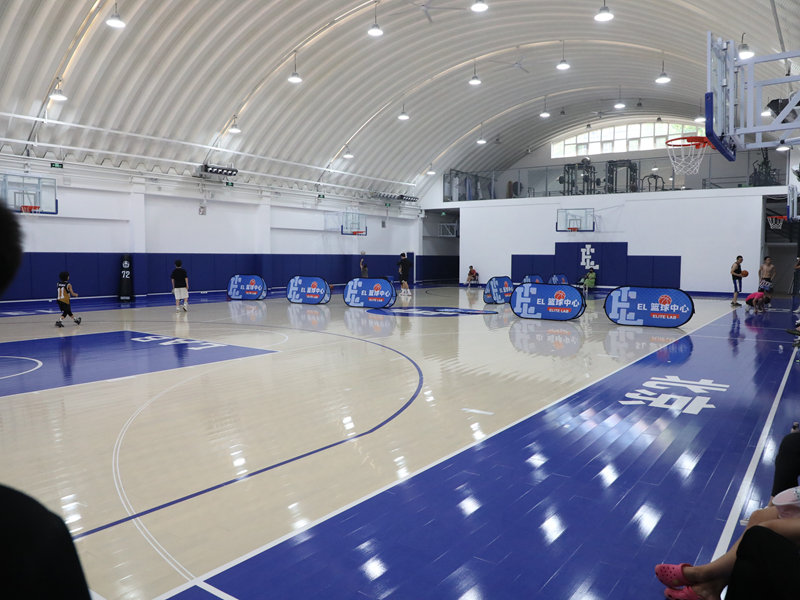
When evaluating any flooring system for an indoor basketball court, performance is the ultimate metric. It does not matter how beautiful the floor looks if it does not perform well under the demands of the game. Interlocking wooden flooring has been engineered specifically to meet the rigorous performance requirements of basketball, and understanding its key characteristics will help you appreciate why it has become the standard for indoor courts around the world.
The first performance characteristic is ball bounce. Basketball is a game of precision. A shot from three-point range requires the ball to bounce off the rim at a predictable angle. A dribble requires consistent contact with the floor. Interlocking wooden flooring provides a ball bounce that closely matches the standards set by governing bodies. The hardwood surface is dense and uniform, which means the ball returns energy efficiently and consistently. Unlike some synthetic surfaces that can feel dead or unpredictable, wood gives the ball a lively, responsive bounce that players trust.
The second characteristic is shock absorption. This is where interlocking flooring truly excels. When a player jumps and lands, the impact force can be several times their body weight. Without adequate shock absorption, this force travels up through the legs and into the joints, increasing the risk of injuries to the knees, ankles, and spine. The base layer of interlocking panels is made from materials like polypropylene, rubber, or a combination of both, which compress under impact and then return to their original shape. This compression absorbs a significant portion of the impact energy, reducing the stress on the player's body. The amount of shock absorption can be tuned by selecting panels with different base materials and thicknesses, allowing you to customize the floor to your specific needs.
The third characteristic is vertical deformation. This refers to how much the floor compresses when a load is applied. For basketball, you want a floor that has enough give to absorb impact but not so much that it feels mushy or unstable. Interlocking wooden flooring is designed to achieve an optimal balance. The wood surface provides a firm, stable platform, while the cushioning base allows for controlled deformation. This combination ensures that players feel confident and secure on their feet, whether they are driving to the basket or planting for a jump shot.
The fourth characteristic is surface friction. Players need a floor that grips their shoes without being so sticky that it causes them to stick and tear their ligaments. Interlocking wooden flooring provides a controlled level of friction that allows for quick cuts, sharp turns, and sudden stops without excessive slipping or sticking. The finish on the wood surface is engineered to maintain this friction consistently, even as the floor ages.
The fifth characteristic is durability under dynamic load. A basketball court floor is subjected to thousands of impacts every day. The interlocking system is designed to withstand this repeated stress without losing its structural integrity. The tongue-and-groove connections are reinforced to prevent separation, and the base material is resistant to compression set, meaning it does not permanently flatten over time.
Together, these performance characteristics make interlocking wooden flooring one of the most well-rounded flooring solutions available for indoor basketball courts. It delivers the response players demand, the protection their bodies need, and the reliability that facility managers require.
Leave a Reply