

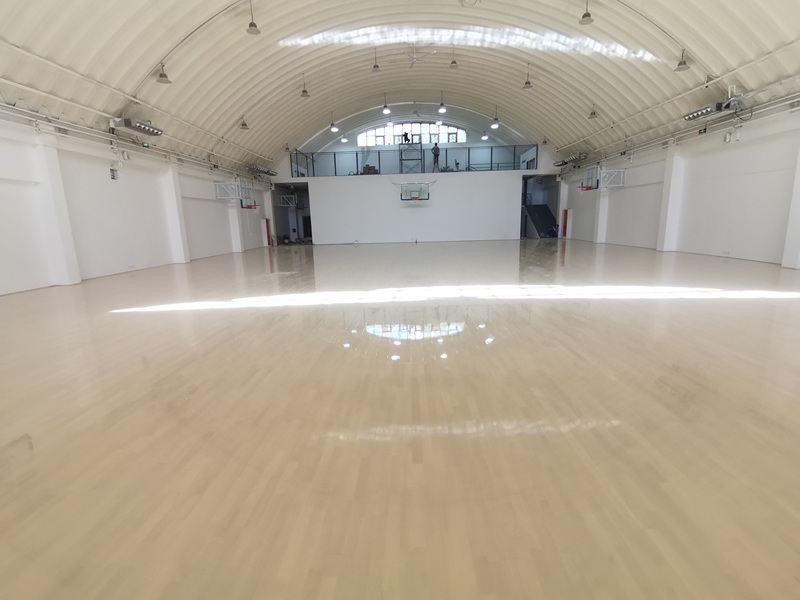
Sports performance is the ultimate test of any basketball court flooring. Players do not care about the engineering behind the product — they care about how the ball bounces, how their feet grip the surface, and how their joints feel after two hours of play. Portable indoor basketball court wooden flooring has made enormous strides in meeting these performance expectations.
Ball bounce is the first thing players notice. Official basketball rules require that a ball dropped from a height of 1.8 meters bounces back to a height between 1.2 and 1.4 meters. Permanent maple hardwood courts consistently achieve this standard. High-quality portable systems with real maple surfaces and proper shock absorption also meet this standard. The key is the combination of surface hardness and underlying shock absorption. Too hard a surface without shock absorption sends too much impact back through the ball, causing an inconsistent bounce. Too soft a surface absorbs too much energy, resulting in a dead bounce. The best portable systems hit the sweet spot — a hard wood surface that provides consistent ball response, backed by a shock layer that protects the player without killing the bounce.
Surface friction, or grip, is equally important. Players need enough friction to stop, change direction, and accelerate without slipping, but not so much that it causes drag or increases the risk of knee injuries. The finish on portable court wood flooring is specifically engineered for this balance. Matte or semi-gloss finishes provide the optimal grip. High-gloss finishes, while visually appealing, can be slippery when sweat is present. Always choose a sports-rated finish with a coefficient of friction between 0.4 and 0.6.
Shock absorption is where portable systems actually have an advantage over many permanent courts. The built-in foam or rubber layer reduces the impact force transmitted to the player's ankles, knees, and hips by fifteen to thirty-five percent compared to bare hardwood. This is particularly important for younger players whose joints are still developing, for recreational players who do not wear professional-grade shoes, and for anyone playing multiple games in a single session. Studies have shown that adequate shock absorption can reduce the incidence of overuse injuries by up to twenty percent.
Energy return is the ability of the floor to give energy back to the player with each step. A good energy return makes players feel faster and more explosive. Permanent hardwood courts have excellent energy return because the wood is rigidly attached to the subfloor. Portable systems can match this if the substructure is stiff enough. Aluminum or steel-framed portable systems offer energy return comparable to permanent courts. Polymer-framed systems tend to have slightly less energy return but better shock absorption.
Temperature can affect performance. Cold floors become slippery and the ball bounces lower. Portable systems installed in unheated spaces may perform poorly in winter. If the court will be used in cold conditions, ensure the facility has adequate heating to maintain a floor temperature above 18°C.
Leave a Reply