

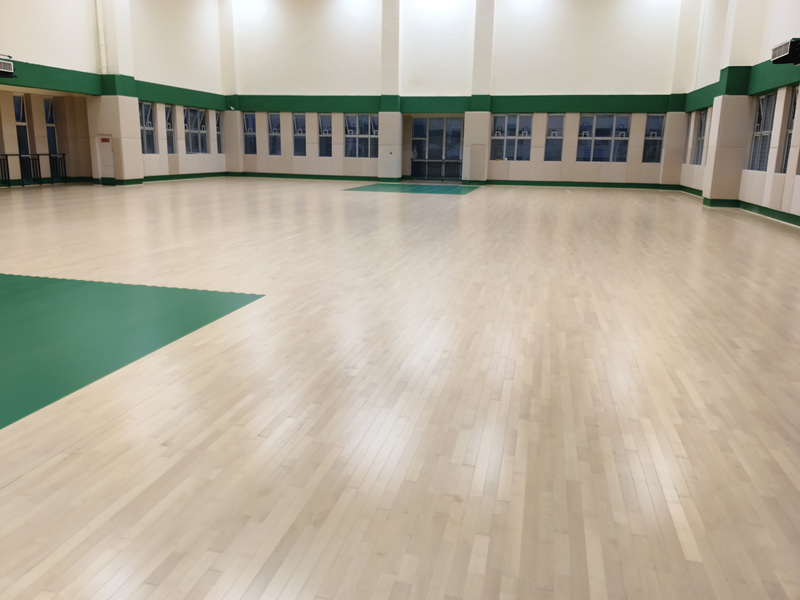
Even with the most consistent and careful maintenance, after 15 to 20 years of heavy use, the finish on indoor basketball court wood flooring will eventually wear down completely, exposing the bare wood underneath in high-traffic areas like the key, the free throw line, and the edges of the court. When this happens, the floor does not need to be replaced entirely—it just needs a full sanding and resurfacing procedure, which strips off all the old finish, a thin layer of worn wood, and any deep scuffs, dents, or scratches, to reveal a fresh, smooth new wood surface that can be refinished to look and perform exactly like a brand new court. This is one of the biggest advantages of wood flooring over synthetic athletic surfaces: a synthetic court has to be completely replaced once its top layer wears out, but a wood court can be resurfaced multiple times, giving it a total usable lifespan of 50 years or more. The full sanding process is a major project that takes several days to complete, and it requires specialized equipment and skilled technicians to do correctly without permanently damaging the wood planks.
The first step of the resurfacing process is to completely empty the court, removing all basketball hoops, benches, score tables, and any other movable objects, and sealing off the gym from the rest of the building to prevent fine wood dust from spreading into other rooms. The technicians then use a large, heavy drum sander that covers a wide swath of the floor in each pass, starting with a very coarse grit sandpaper that strips off all the old finish, the top layer of worn wood, and all the deep scratches and dents. This first pass is the most aggressive, and it removes around 1/32 of an inch from the entire surface of the wood, enough to eliminate almost all signs of decades of play. The technicians make multiple overlapping passes across the entire court, first going with the grain of the wood, then making diagonal passes to ensure that every spot on the surface is evenly sanded, with no remaining old finish or uneven high spots. After the coarse sanding is complete, they go over the entire floor again with progressively finer grits of sandpaper, each time removing the scratches left by the previous grit, until they are using an extremely fine grit that leaves the wood surface perfectly smooth and completely uniform.
Once the sanding is finished, all the fine wood dust is completely vacuumed up from every inch of the court, including the gaps between planks and the edges along the walls, until the surface is completely clean and dust-free. At this point, the technicians can apply the new court markings: the lines for the boundaries, three-point arcs, free throw lanes, and center circle are all painted directly onto the bare wood using a high-quality, durable athletic line paint that will not peel or wear off quickly. Once the line paint is fully dry, multiple coats of the new athletic finish are applied, with light sanding between each coat to create a strong, perfectly smooth, high-traction surface. When the final coat of finish is fully cured, usually after 24 to 48 hours, the court is ready to be used again. A properly done full sanding and resurfacing can make a 20-year-old indoor basketball court wood flooring feel brand new, restoring all the original performance characteristics, traction, and shock absorption that it had when it was first installed. This ability to be renewed again and again is one of the reasons that wood basketball courts are such a valuable long-term investment for any venue.
Leave a Reply