

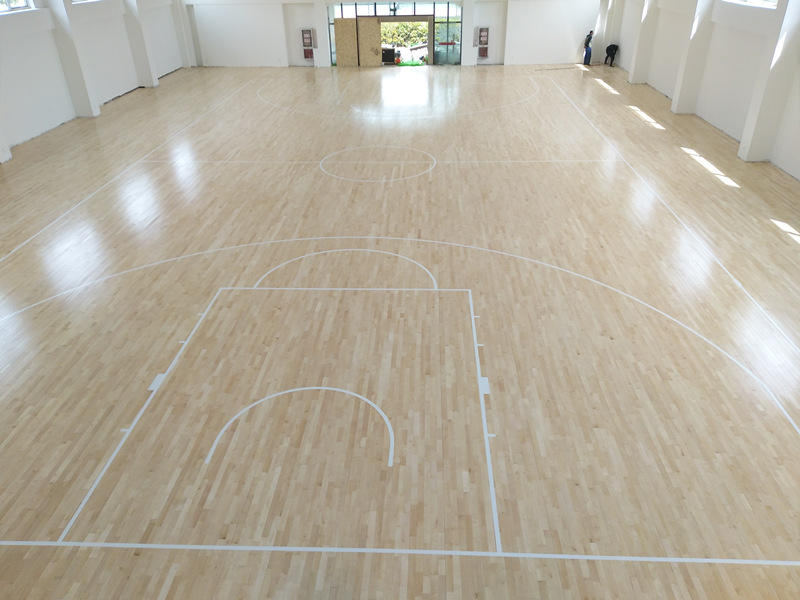
One of the most defining features of portable indoor basketball court wood flooring is its remarkably straightforward installation process, which does not require specialized construction teams or heavy power tools. Unlike permanent wood flooring that requires weeks of work to lay down keels, install moisture barriers, level the subfloor and secure every panel with adhesive and nails, a full portable basketball court can be set up by a small team in just a few hours. This accessibility means that even groups with no professional construction experience can learn to assemble the court properly after a short training session, removing the need to hire expensive specialized contractors for every setup.
The process always starts with preparing the underlying base surface, which does not need to be a perfectly modified professional sports subfloor. The existing indoor concrete, tile or even smooth vinyl floor only needs to be fully cleaned, cleared of any small debris, and checked for minor uneven spots that could create small bumps under the portable panels. A thin, lightweight protective underlay sheet is laid down across the full planned court area first, to create a soft buffer between the wood panels and the hard underlying floor, add extra shock absorption, and prevent any small particles from scratching the back of the wood panels during use. This underlay also provides a small amount of sound insulation, reducing the noise that travels down to the floors below the playing space.
Once the underlay is fully in place, the assembly of the wood panels begins from one corner of the marked court area. Each panel is designed with precision interlocking edges that fit together perfectly, no nails, screws or strong adhesive are required to hold them in place. The panels are simply pressed together gently until the interlocking mechanism clicks into place, creating a tight, seamless connection that leaves no gaps between adjacent sections. As the team works their way across the court, they can use a soft rubber mallet to gently tap any panels that are not fully locked in, ensuring every joint is completely secure and flush, with no uneven edges that could disrupt play.
After all the main wood panels are laid down, the final steps include installing the matching edge trim pieces that create a smooth transition between the wood court surface and the surrounding floor, and then applying the official court marking lines. The lines for the three point arc, free throw lane and center circle can be applied with specialized non-marking tape designed for wood sports surfaces, which adheres firmly during play but can be removed later without leaving sticky residue or damaging the wood finish. Once the full court is assembled, the team does a final walk across the entire surface to check for any loose panels, uneven spots or small gaps, making minor adjustments to ensure the entire playing area is completely safe and ready for use. The entire process can be reversed just as quickly when the court needs to be taken down, with panels unlocked, stacked carefully and moved to storage in a fraction of the time it would take to remove a permanent wood floor.
Leave a Reply