

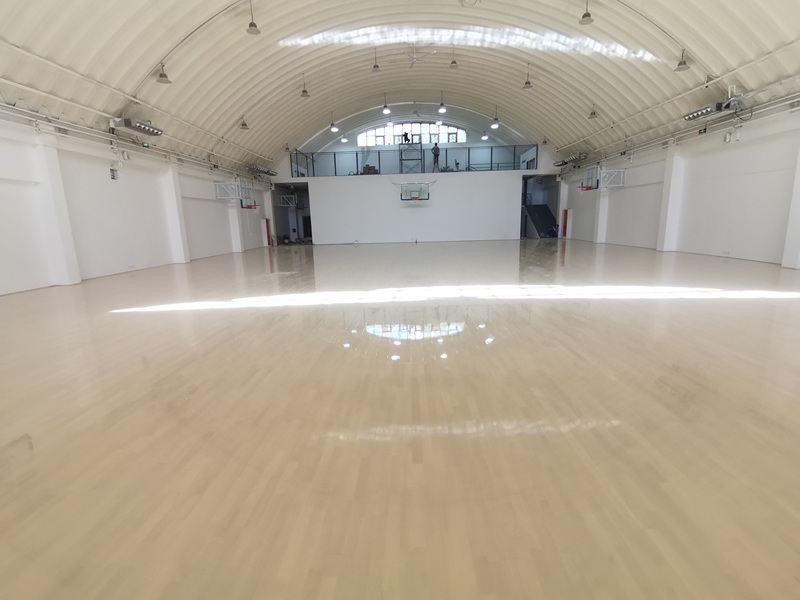
Many people worry that the printing process will affect the structural stability of indoor sports wooden flooring, but in fact, the modern optimized printing process not only does not damage the structural performance of the floor, but also further enhances the overall stability of the floor through the pretreatment of the process.
Before the printing process is carried out, the surface of the wooden floor base material will go through a series of precise pretreatment processes, including multiple procedures such as fine sanding, pore sealing and stress relief. These pretreatment processes can effectively eliminate the internal stress of the wood base material, avoid the problems of deformation and cracking caused by the release of internal stress during the subsequent use of the floor. At the same time, the pore sealing treatment can seal the tiny pores on the surface of the wood, prevent the moisture in the ink from penetrating into the interior of the wood, and avoid the problem of local expansion and deformation of the base material caused by the infiltration of liquid.
The printing process itself is a low-temperature and short-time treatment process. The UV ink is instantly cured under the irradiation of ultraviolet light, and the entire curing process does not need high-temperature baking, which will not cause the wood base material to lose water and deform due to high temperature. Compared with the traditional paint drying process that requires long-term high-temperature baking, the printing process has almost no thermal damage to the internal structure of the wood, and completely retains the natural mechanical properties of the wood, such as impact resistance and elasticity.
After the pattern is printed, the multi-layer protective structure formed by the subsequent wear-resistant paint can also form a closed protective layer on the surface of the entire floor. This closed protective layer can effectively isolate the influence of external moisture and dry air on the wood base material, reduce the deformation of the floor caused by the change of ambient humidity, and further enhance the dimensional stability of the floor. In the southern humid areas and the northern dry areas, the sports wooden flooring using this printing process structure can maintain a very low deformation rate during long-term use, avoiding the common problems of floor arching, cracking and other problems in traditional solid wood floors.
The precise positioning technology of the printing process can also cooperate with the floor assembly process to realize the precise alignment of the pattern at the splicing gap of the floor. The traditional solid wood floor paving is easy to have the problem of pattern dislocation at the splicing place, which affects the overall aesthetic feeling. The printed floor can pre-set the pattern position of each floor board through the digital typesetting system, and mark the corresponding assembly number on the back of the board. During the on-site paving process, the workers can complete the seamless splicing of the pattern according to the number, so that the wood grain or customized pattern of the entire venue floor is connected as a whole, which greatly improves the overall paving effect of the floor.
Leave a Reply