

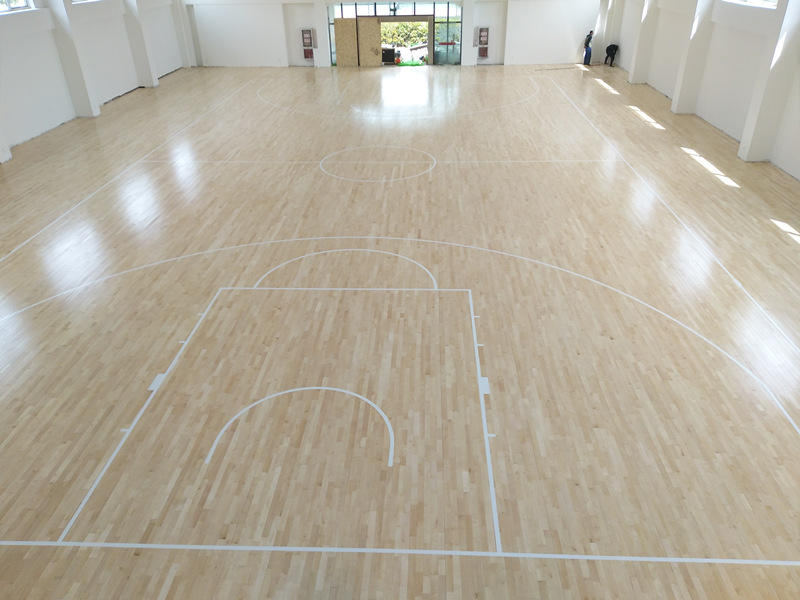
What most spectators see during a basketball game is only the thin, polished top layer of a basketball court wooden floor, but the real engineering magic that delivers its legendary performance is hidden in the multi-layer support system installed beneath the surface wood planks. A modern professional basketball court wooden floor is never just a single layer of wood nailed directly to a concrete slab, because that simple construction would fail to deliver the shock absorption, dimensional stability, and controlled vertical deflection that competitive play requires. The very first layer in the system, installed directly on top of the building’s concrete base, is a moisture barrier designed to block any water vapor that seeps up through the concrete, a common issue in underground or ground-level indoor sports facilities. Without this barrier, trapped moisture would warp the wooden planks above, causing them to cup, buckle, or separate at the seams, creating dangerous uneven edges across the court. Above the moisture barrier lies a network of resilient pads, often made from a combination of rubber and composite materials, that are precisely spaced to create a uniform, flexible base for the entire floor. These pads are calibrated to compress a specific amount under impact, working in tandem with the wood layers above to deliver the exact level of shock absorption required for competitive play. This layer is the reason a professional basketball court wooden floor feels slightly springy underfoot, rather than feeling like a rigid slab of wood sitting on concrete. On top of these resilient pads, installers lay a subfloor structure made from strong, dimensionally stable wood panels that create a flat, even base for the final playing surface. This subfloor distributes the weight of every player evenly across the entire support system, preventing localized dips or soft spots from forming even in the highest-traffic areas of the court. Some advanced systems also include a network of small, adjustable sleepers in this subfloor layer, which allow technicians to fine-tune the height of every section of the floor to ensure absolute flatness across the entire 94-foot length of a standard full-size court. The final top layer, the one that players actually run on, is the carefully selected hardwood planks, milled to a precise thickness and installed with tight, uniform seams that leave no gaps for dirt or moisture to accumulate. Every single layer in this system is designed to work in harmony: if one component is installed incorrectly or fails to meet performance standards, the entire basketball court wooden floor will underperform, no matter how high-quality the top hardwood planks are. This layered construction is the result of more than 70 years of iterative design, refined through millions of hours of professional play to create a surface that perfectly balances energy return, impact protection, and long-term stability.
The Hidden Multi-Layer Structure Beneath a Professional Basketball Court Wooden Floor
Leave a Reply