

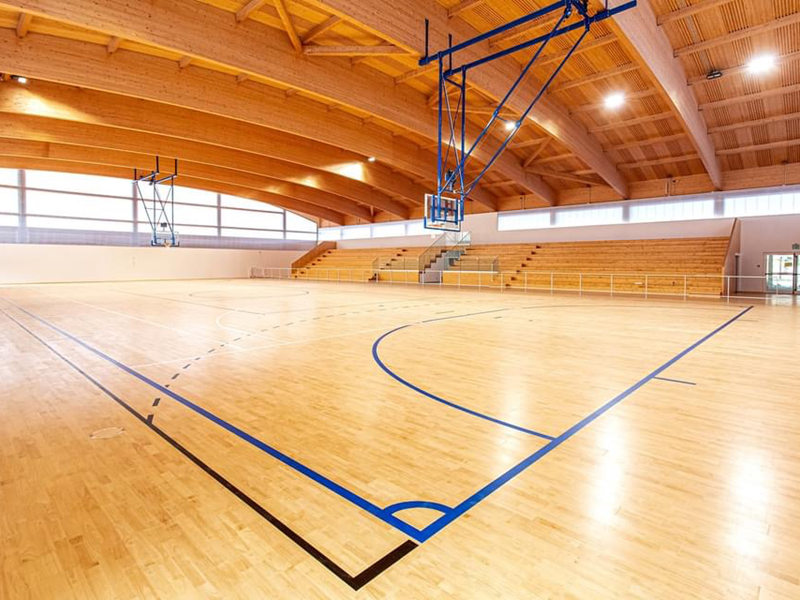
The world of sports flooring has undergone a remarkable transformation over the past decades, and at the heart of this progress lies the continuous advancement of printing technology applied to modular sports wooden flooring. What once began as a simple process of applying basic color coatings to wooden panels has evolved into a highly sophisticated digital manufacturing discipline that redefines both the aesthetic and functional possibilities of athletic surfaces. In the early days of sports facility construction, wooden flooring for gymnasiums and competition venues relied almost entirely on natural wood grain patterns, with manual staining and hand-painted markings that required hours of skilled labor yet often resulted in inconsistent color distribution and limited design flexibility. The introduction of modern printing techniques marked a turning point, allowing manufacturers to replicate the most intricate natural wood textures with unprecedented precision while also introducing entirely new visual dimensions that were impossible to achieve through traditional wood treatment methods.
As printing technology matured, it began to address not just the visual appearance but also the core performance characteristics that define high-quality sports wooden flooring. The process of transferring detailed patterns directly onto prepared wood substrates eliminated many of the limitations of older surface treatment methods, enabling consistent texture reproduction across hundreds of individual flooring panels that would later be assembled into a seamless playing surface. This evolution has been particularly significant for modular sports wooden flooring systems, where each individual plank must maintain perfect visual continuity with its neighbors despite being produced in separate manufacturing runs. Modern printing systems can now ensure that every single panel carries matching grain patterns, color saturation, and surface texture, creating a unified visual experience across entire competition courts that spans thousands of square meters.
The integration of printing technology into modular sports wooden flooring production has also brought about important practical benefits for facility operators. Unlike traditional solid wood flooring that requires extensive on-site finishing work after installation, pre-printed modular panels arrive at the venue with their complete surface treatment already applied, dramatically reducing installation time and eliminating the need for potentially disruptive on-site painting or staining processes. This is especially critical for sports venues that operate on tight schedules, where minimizing downtime between events can directly impact operational efficiency and revenue generation. The evolution continues today, with new printing methodologies being developed that enhance not just visual appeal but also the functional properties of the flooring surface, creating athletic surfaces that perform better, last longer, and offer greater design freedom than ever before imagined.
Leave a Reply