

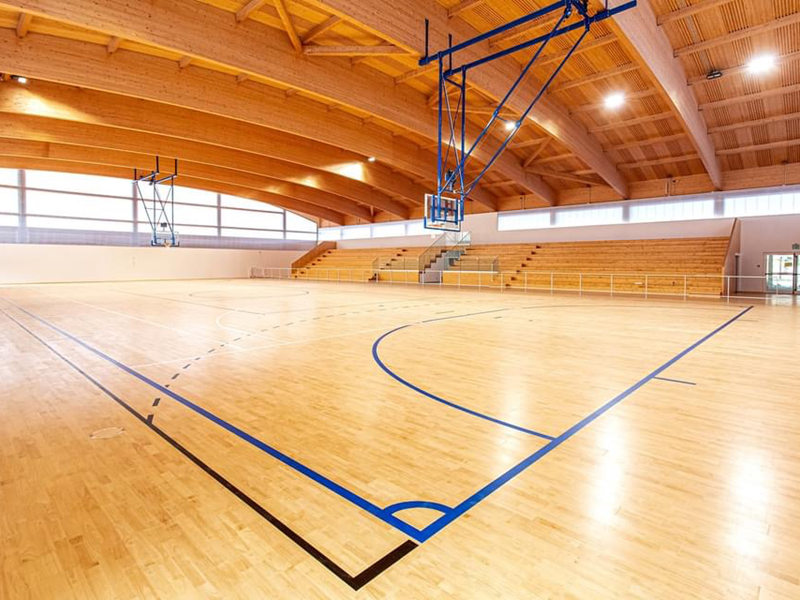
When planning or renovating an indoor basketball facility, the choice of wooden flooring stands as one of the most impactful decisions you will make. Unlike ordinary residential or commercial flooring, basketball court wooden flooring is engineered to meet strict performance standards that directly influence player safety, game quality, and the overall lifespan of your venue. This guide breaks down every critical aspect of selecting the right wooden floor for your indoor basketball space, starting with the core functional requirements that set sports-specific wood flooring apart from all other options.
At its most fundamental level, indoor basketball court wooden flooring must satisfy four non-negotiable performance criteria: slip resistance, shock absorption, structural stability, and environmental health. The surface friction coefficient should consistently fall between 0.4 and 0.7, a carefully calibrated range that prevents players from slipping during sharp cuts and sudden stops, while also avoiding excessive resistance that could strain ankles and knees. High-quality shock absorption systems are designed to dissipate at least 53% of the impact force generated when a player jumps and lands, drastically reducing the risk of chronic joint injuries, stress fractures, and muscle fatigue that can come with hours of play on a hard, unforgiving surface. A reliable basketball court wooden floor must also deliver a ball bounce recovery rate of 90% or higher, ensuring that the ball responds uniformly across every inch of the court, with no dead spots that could alter the flow of a competitive game.
The history of basketball court wooden flooring stretches back to the early 20th century, when the first dedicated indoor basketball arenas began replacing rough concrete and dirt surfaces that left players vulnerable to serious injury. Over the decades, the technology behind these floors has evolved dramatically, moving from simple, flat nailed-down planks to sophisticated multi-layer elastic systems that combine multiple components to deliver optimal performance. Today, the best indoor basketball court wooden flooring systems are certified to meet international standards, ensuring that they can withstand thousands of hours of high-intensity play, from casual pickup games to elite professional matches, without warping, denting, or losing their core functional properties.
Choosing the right basketball court wooden flooring is not a one-size-fits-all process. The needs of a small community recreation center are very different from those of a professional competition arena, and understanding your venue’s primary use case, expected foot traffic, and long-term maintenance capacity will help you narrow down the options that align with both your performance goals and your budget. This guide will walk you through every step of the process, from selecting the right wood species and panel thickness, to understanding the hidden structural layers that make a floor safe and durable, to planning for proper installation and long-term care that will keep your court in top condition for decades.
Leave a Reply