

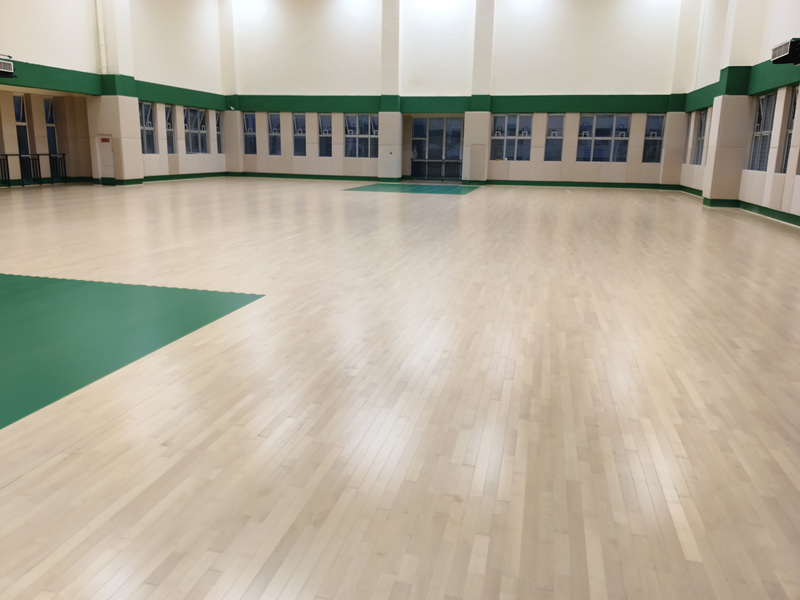
What makes a detachable indoor sports wood floor actually work? The answer lies in some clever engineering that operates mostly beneath the surface, invisible to the athletes playing on top.
The top layer is hardwood, typically maple, oak, or beech, selected for its density and grain structure. Maple is the most common choice for basketball courts because it provides an excellent balance of hardness, grip, and ball rebound. The wood is kiln-dried to a precise moisture content, usually between six and nine percent, to ensure dimensional stability. The planks are then milled to exact thickness and width, and a UV-cured finish is applied. This finish is not just for appearance. It is a critical performance component that affects friction, durability, and maintenance requirements.
Beneath the hardwood is the structural core. This is usually a multi-layer plywood or high-density fiberboard panel that gives the floor its rigidity. The core must be stiff enough to prevent excessive deflection under load but not so rigid that it transmits all the impact force back to the athlete. This balance is achieved through the thickness and composition of the core layers.
The most innovative part of a detachable system is the connection mechanism. Early detachable floors used simple tongue-and-groove joints, which worked but were not very secure under heavy lateral loads. Modern systems use patented locking mechanisms that engage both horizontally and vertically. Some use a cam-lock system where a lever or tool secures the panels together with a clamping force of several hundred kilograms per connection. Others use a spring-loaded clip system that snaps into place and can be released with a simple tool. The key engineering challenge is to create a connection that is strong enough for athletic use but easy enough to release for disassembly.
The underlayment system is where the sports performance is really engineered. The shock-absorption layer is made from materials like polyethylene foam, natural rubber, or a combination. The thickness and density of this layer are precisely calculated based on the target sport's requirements. For basketball, the standard is a vertical deformation of between 2.3 and 5.3 millimeters. The underlayment is cut to match the panel layout, so each panel sits on its own cushioned zone.
The entire system is designed as an integrated unit. The hardwood, the core, the connection, and the underlayment all work together. Change one component, and you affect the performance of the others. This is why it is important to buy from a manufacturer that designs the complete system rather than mixing components from different suppliers.
Leave a Reply