

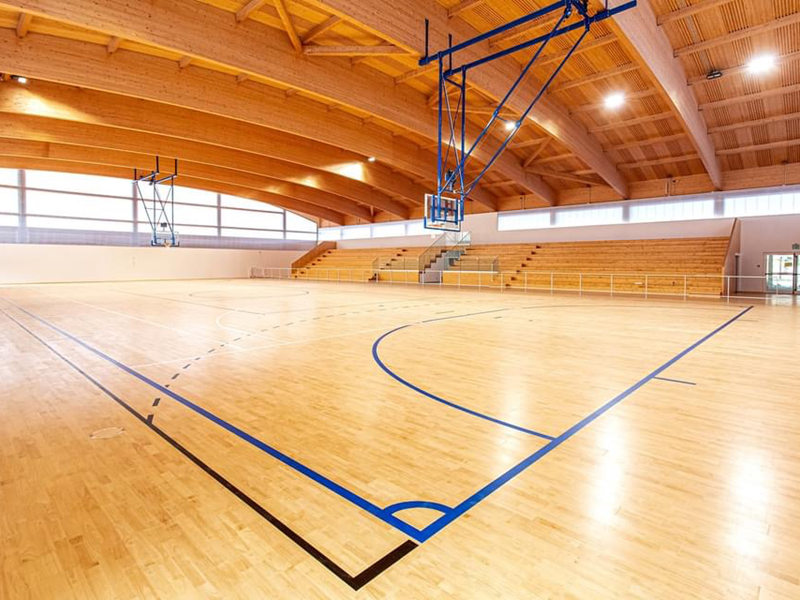
Indoor basketball court wood flooring is not just a decorative surface for sports venues; it is a highly engineered system built to balance athletic performance, long-term durability, and consistent playing feel for every player. The entire structure starts from the subfloor layer, which is laid directly on the concrete base of the venue. This layer is designed to adjust the flatness of the ground and create a stable foundation that prevents the upper layers from shifting or cracking under long-term heavy use. Above the subfloor, a cushioning layer made of elastic materials is installed, which is the key to absorbing the impact generated when players jump, land, and make sudden stops. This cushioning layer does not make the floor feel overly soft, which would otherwise affect the stability of players’ movements, but rather provides a controlled level of elasticity that reduces the pressure transmitted to athletes’ knees, ankles, and spines during intense games.
The top layer, the actual wood surface that players step on, is carefully selected for its natural fiber structure and consistent density. Every piece of wood used here is processed through multiple stages of drying to ensure its moisture content matches the average humidity of the indoor venue environment. This strict moisture control process prevents the wood from expanding excessively in humid seasons or shrinking and forming gaps during dry periods, two common issues that can create uneven spots on the court and increase the risk of player injuries. The arrangement of the wood planks also follows specific rules, usually laid along the long axis of the basketball court to create a uniform visual flow and ensure that the force of players’ movements is distributed evenly across the entire surface. Even the seams between each plank are treated with precision to eliminate any raised edges that could catch the sole of a basketball shoe during a quick cut.
Beyond the basic layers, hidden structural details play a huge role in the floor’s long-term performance. Small ventilation gaps are reserved between different layers of the system, allowing air to circulate gently under the wood surface. This circulation prevents moisture from being trapped between the concrete base and the wood, which would otherwise lead to warping, mold growth, or premature decay of the material. The edge areas of the court, which often bear extra impact from players running close to the boundaries, are reinforced with additional structural supports to match the performance of the central playing area. This ensures that there are no "weak spots" anywhere on the court, so every player can trust that the floor will respond the same way no matter where they move during a game.
Leave a Reply