

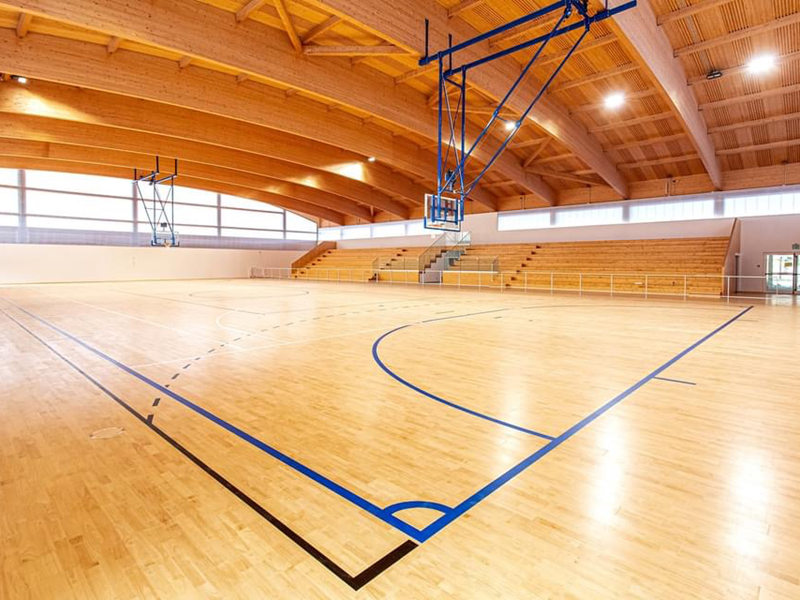
Assembled indoor sports wood flooring represents a revolutionary breakthrough in traditional sports venue construction, with its core structural logic rooted in the pursuit of both professional sports performance and flexible deployment capabilities. Unlike the permanently laid solid wood flooring systems that require on-site adhesive bonding and long-term curing, this assembled system is composed of multiple independent modular units that can be directly spliced together without any permanent fixing materials. Each modular unit is precision-cut to a uniform size, with interlocking notches milled on all four edges that fit seamlessly with adjacent units, forming a continuous, stable surface without visible gaps after installation. The base layer of each module is designed with a shock-absorbing buffer structure, usually made of high-density elastic composite materials that can disperse the impact force generated by athletes’ jumps and rapid movements across a wider area, effectively reducing the load on the athlete’s knee joints and ankles. The surface layer is made of high-quality solid wood or engineered wood panels, treated with a special non-slip coating that maintains a consistent friction coefficient across the entire surface, ensuring that athletes can make sharp turns, sudden stops, and high jumps without the risk of slipping or losing balance. This structural design also eliminates the hidden dangers caused by traditional flooring’s long-term exposure to moisture, as each modular unit has a certain degree of independent deformation tolerance, preventing the entire floor from warping or arching due to partial moisture intrusion.
The Core Structural Logic of Modular Assembled Indoor Sports Wood Flooring
Leave a Reply