

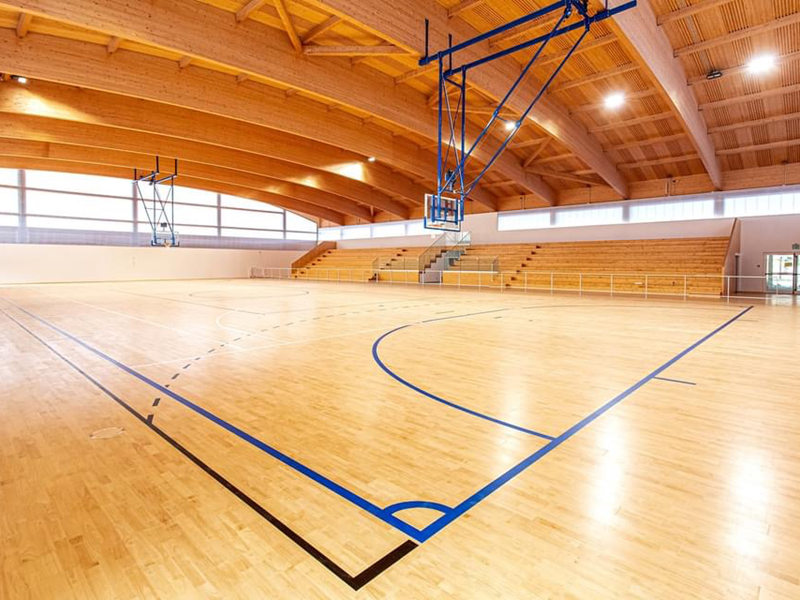
When you step onto a professional indoor basketball court, the first thing you notice beneath your sneakers is the subtle, responsive give of the wooden floor that has been engineered over decades to meet the sport’s most demanding needs. A standard basketball game involves constant explosive movements: sudden direction changes, vertical leaps for rebounds, hard landings after dunks, and quick lateral shuffles on defense. All of these actions place enormous stress on both the athletes’ bodies and the surface they play on, which is why a properly constructed basketball court wooden floor is far more than a simple layer of wood nailed to a concrete base. The most fundamental performance requirement for any basketball court wooden floor is consistent ball bounce across every square foot of the playing area. Unlike hard, unyielding surfaces such as bare concrete or asphalt, a well-made wooden floor uses the natural elasticity of wood fibers to return a predictable percentage of energy to a bouncing basketball, ensuring that every dribble, every pass off the floor, and every bounce of a missed shot behaves exactly as players expect it to. This consistency eliminates unexpected variables that could disrupt a player’s rhythm, allowing them to focus entirely on their technique rather than second-guessing how the ball will react when it hits the ground. Beyond ball bounce, shock absorption is the second non-negotiable feature of a quality basketball court wooden floor. When a 200-pound athlete lands from a 30-inch vertical jump, their body generates a force several times their body weight, and a floor that fails to absorb a significant portion of that impact will send nearly all that stress directly to their knees, ankles, and lower back. Over the course of a long season, repeated exposure to that unmitigated impact leads to chronic overuse injuries that can cut careers short, which is why modern basketball court wooden floor systems are designed to reduce peak impact forces by a carefully calibrated percentage, striking a perfect balance between softness and firmness. If a floor is too soft, it will feel mushy underfoot, causing players to sink slightly when they push off for a sprint and wasting the energy they put into their movement. If it is too hard, it offers no meaningful protection against impact, defeating the entire purpose of using wood instead of a cheaper synthetic alternative. This delicate equilibrium is what separates a professional-grade basketball court wooden floor from a simple residential hardwood floor that has been repurposed for sports use. Even the smallest deviation in this balance can alter the entire experience of playing the game, turning a high-energy competitive match into a frustrating, potentially dangerous session for everyone involved.
The Core Performance Principles That Define a High-Quality Indoor Basketball Court Wooden Floor
Leave a Reply