

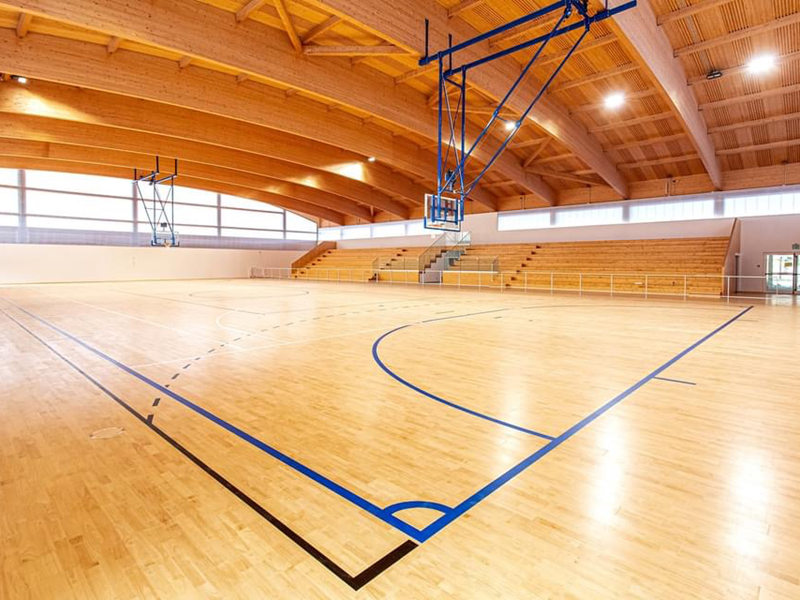
When designing an indoor basketball space, the performance of indoor basketball court wood flooring directly shapes every movement of players, from a gentle dribble to a powerful dunk. Unlike ordinary residential wood flooring, this specialized surface must meet strict athletic performance benchmarks that prioritize both playability and long-term safety. The most critical metric is shock absorption, which refers to how much the floor compresses when a player lands from a jump. A properly engineered system will reduce the impact transmitted to a player’s knees and ankles by more than half, a detail that prevents chronic joint injuries even after hours of continuous play. Another non-negotiable standard is ball rebound consistency, which ensures a basketball bounces at a uniform height across every inch of the court. If one section of the floor returns less bounce than another, players will unconsciously adjust their dribble pressure, breaking their natural rhythm and increasing the risk of turnovers during competitive games. Friction control is equally important: the surface must offer enough grip to let players make sharp, sudden stops without slipping, but not so much traction that their shoes stick to the ground and cause awkward twists to the lower legs. Every layer of the indoor basketball court wood flooring system works together to hit these exact performance marks, turning a simple wood surface into a tool that supports, rather than hinders, elite level basketball play.
The Core Athletic Performance Standards of Indoor Basketball Court Wood Flooring
Leave a Reply