

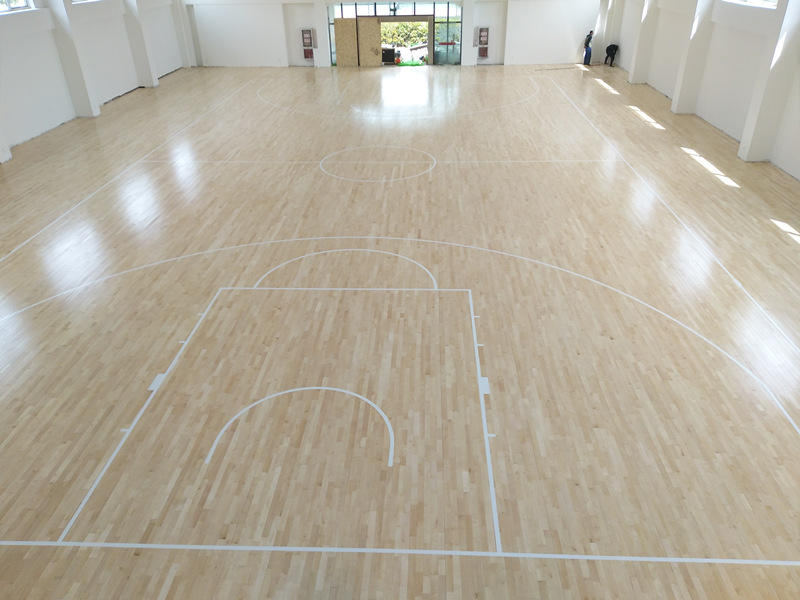
Installing a wooden basketball court is one of the most complex and precise construction projects you can undertake. Unlike installing wood flooring in a home, a basketball court requires an engineered system that can withstand extreme forces, provide consistent performance, and last for decades. Every step of the installation process must be executed with care and precision. In this article, we will walk you through the complete installation process, from preparation to the final finish.
Step 1: Planning and Design
Before any work begins, you need a detailed plan. This includes the dimensions of the court, the location of the facility, the intended use (professional, collegiate, recreational), and the budget. You will also need to decide on the wood species, plank width, finish type, and any custom markings or logos.
It is essential to consult with a professional basketball court flooring contractor at this stage. They can help you navigate the various options and ensure that your design meets the requirements of any governing bodies that may oversee play on the court. For example, if you are building an NCAA court, the contractor must ensure that the floor meets all NCAA specifications.
Step 2: Subfloor Preparation
The subfloor is the foundation of your basketball court, and its quality directly affects the performance of the finished floor. Most basketball courts are built on a concrete subfloor, which must be perfectly flat, clean, and dry. Any cracks, bumps, or moisture issues must be addressed before installation begins.
The concrete is typically poured to a specific thickness, usually 100 to 150 millimeters, and reinforced with steel rebar or wire mesh for strength. After the concrete cures, which can take 28 to 60 days depending on the conditions, it must be tested for moisture content. The moisture level should be below 3 percent for glue-down installations or below 5 percent for nail-down installations. If the moisture level is too high, a moisture barrier must be installed.
Step 3: Moisture Barrier Installation
A moisture barrier is a critical component of any basketball court floor system. It prevents moisture from the concrete subfloor from migrating up into the wood, which can cause warping, cupping, and other damage. The most common moisture barriers used are polyethylene sheeting or specialized membrane products.
The barrier is laid over the entire subfloor and sealed at the seams with tape. It is important to ensure that there are no gaps or tears in the barrier, as even a small opening can allow moisture to seep through.
Step 4: Installing the Support Layer
On top of the moisture barrier, a support layer is installed. This is typically plywood or oriented strand board (OSB) that provides structural stability and helps distribute the load evenly across the subfloor. The support layer is usually 18 to 25 millimeters thick and is fastened to the subfloor with concrete screws or adhesive.
The joints between the sheets of plywood or OSB should be staggered to prevent weak points in the floor. The entire support layer must be level, with no more than 2 millimeters of variation over a 3-meter span.
Step 5: Laying the Wood Planks
This is the most visible and exciting part of the installation process. The individual wood planks are laid on top of the support layer, typically running lengthwise along the court. The planks are usually 60 to 70 millimeters wide and 20 to 22 millimeters thick for professional courts.
There are two primary methods for attaching the planks: nail-down and glue-down. In a nail-down installation, the planks are fastened to the support layer with cleats and nails or screws. This method allows for easier replacement of individual planks if damage occurs. In a glue-down installation, the planks are bonded to the support layer with a specialized adhesive. This method provides a more solid, uniform surface but makes individual plank replacement more difficult.
The planks must be laid with precision, maintaining consistent spacing and alignment. Any gaps between planks are filled with wood filler, and the entire surface is sanded smooth.
Step 6: Sanding and Refinishing
Once all the planks are installed, the entire floor is sanded to create a perfectly smooth, level surface. This process typically involves three stages of sanding, starting with a coarse grit and progressing to a fine grit. After each sanding stage, the floor is cleaned of dust and debris.
After the final sanding, the floor is ready for the finish. A polyurethane or water-based polyurethane coating is applied in multiple coats, with sanding between each coat. The number of coats varies depending on the desired gloss level and durability, but typically ranges from five to ten coats.
Step 7: Painting Court Lines and Markings
The final step is to paint the court lines, logos, and any other markings. This is done using stencils and specialized paints that are designed to bond with the floor finish. The lines must be precise and meet the specifications of the governing body for which the court is being built.
Once the paint is dry, the court is ready for play. However, it is important to allow the finish to cure fully before heavy use, which can take several days to a week depending on the type of finish used.
In conclusion, installing a basketball court wooden floor is a meticulous process that requires expertise, precision, and quality materials. When done correctly, the result is a playing surface that will provide outstanding performance for decades to come.
Leave a Reply