

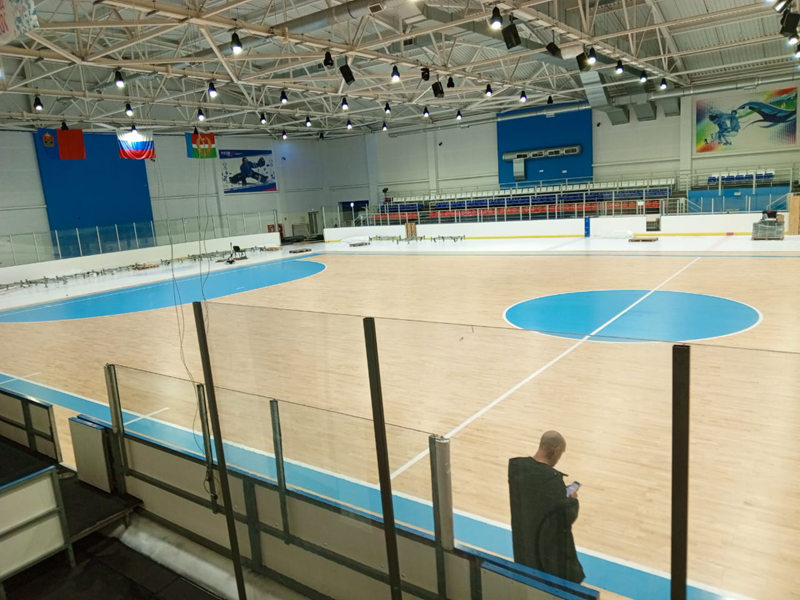
The installation of indoor sports wooden flooring is a precise, multi-step process that requires skilled craftsmanship and attention to detail. A poorly installed floor can lead to squeaking, uneven surfaces, poor ball performance, and premature wear. In this comprehensive guide, we walk you through every step of the installation process, from subfloor preparation to final finishing.
Phase 1: Pre-Installation Planning (1-2 Weeks Before)
Before any work begins, thorough planning is essential:
1.1 Subfloor Inspection
The subfloor must be inspected for:
- Flatness: The floor must be level within 2mm over a 2-meter span (EN 14904 standard).
- Moisture Content: Concrete subfloors must have a moisture content below 3%. Wood subfloors should be at 8-12% moisture content.
- Structural Integrity: The subfloor must be able to support the weight of the flooring system (approximately 15-20 lbs per square foot for solid hardwood).
1.2 Acclimatization
Wood flooring must be acclimatized to the installation environment for at least 48-72 hours. The planks should be stored in the room where they will be installed, at a temperature of 60-80°F (15-27°C) and relative humidity of 40-60%.
1.3 Material Layout
Plan the layout of the planks to:
- Minimize waste (typically 5-10% waste factor)
- Ensure uniform color distribution
- Align with the primary direction of play (usually parallel to the sidelines for basketball)
Phase 2: Subfloor Preparation (2-5 Days)
2.1 Plywood Subfloor (For Nail-Down Installation)
- Install 3/4" (19mm) CDX or better plywood over the joists.
- Stagger the seams and secure with screws (not nails) every 6 inches.
- Apply construction adhesive between the plywood and joists to prevent squeaking.
- Sand the plywood smooth and vacuum thoroughly.
- Apply a moisture barrier (6-mil polyethylene) if the subfloor is concrete or has moisture concerns.
2.2 Concrete Subfloor (For Glue-Down or Floating Installation)
- Grind or sand the concrete to remove high spots and create a smooth surface.
- Fill cracks and voids with epoxy or self-leveling compound.
- Apply a primer to ensure proper adhesion of the adhesive.
- Apply a moisture barrier (6-mil polyethylene or liquid membrane).
- Allow the primer and moisture barrier to cure completely (usually 24-48 hours).
Phase 3: Floor Installation (3-7 Days)
3.1 Nail-Down Installation (Solid Hardwood)
- Start from the wall: Leave a 3/8" to 1/2" expansion gap around the perimeter.
- First row: Face-nail the first row to the subfloor using a pneumatic flooring nailer. Nails should be 2" long and driven at a 45-degree angle through the tongue of the plank.
- Subsequent rows: Use a mallet and tapping block to tight-fit the planks together. Stagger end joints by at least 12 inches (preferably 24+ inches) between rows.
- Nailing pattern: Nail every 8-12 inches along each joist. Use a ring-shank or spiral-shank nail for maximum holding power.
- Cutting: Use a table saw or circular saw for rip cuts and a jigsaw or bandsaw for end cuts around obstacles.
3.2 Glue-Down Installation (Engineered Wood)
- Apply a thin, even layer of urethane-based sports flooring adhesive to the subfloor using a notched trowel (1/4" x 1/4" notches).
- Press the first plank firmly into the adhesive, starting from the wall with a 3/8" expansion gap.
- Roll each subsequent plank with a 100-lb roller to ensure full contact with the adhesive.
- Wipe away excess adhesive immediately with a damp cloth.
- Allow 24-48 hours for the adhesive to cure before walking on the floor.
3.3 Floating Installation (Engineered Wood)
- Lay a foam underlayment (3-6mm) over the subfloor to provide sound insulation and minor leveling.
- Start from the wall with a 3/8" expansion gap, using spacers.
- Click the tongue-and-groove planks together. For engineered floors, a floating installation is the most common method.
- Stagger end joints by at least 12 inches.
- The final row may need to be ripped to fit.
Phase 4: Finishing (2-5 Days)
4.1 Sanding
- Initial sanding (80-grit): Remove any high spots, adhesive residue, or mill marks.
- Medium sanding (100-120 grit): Smooth the surface and prepare for finishing.
- Fine sanding (150-180 grit): Create a smooth, even surface for the finish to adhere to.
- Vacuum thoroughly between each sanding pass.
4.2 Line Painting
- Apply masking tape along all court lines, zones, and logos.
- Use sports-grade line paint (water-based polyurethane paint) for durability.
- Apply 2-3 coats, allowing each coat to dry completely (usually 2-4 hours).
- Remove masking tape while the paint is still slightly tacky to prevent peeling.
4.3 Finish Application
- First coat: Apply a thin, even coat of sports lacquer (water-based polyurethane) using a high-quality applicator. Allow to dry for 2-4 hours.
- Light sanding (220-grit): Between coats, lightly sand to remove any dust nibs or imperfections.
- Second coat: Apply a second coat in the same manner.
- Third coat (optional): For high-traffic areas, a third coat provides extra durability.
- Allow the final coat to cure for at least 24-48 hours before use.
Phase 5: Final Inspection and Testing
- Flatness test: Use a 2-meter straightedge to verify the floor is level within 2mm.
- Ball rebound test: Use a certified ball rebound tester to verify compliance with DIN/EN/FIBA standards.
- Shock absorption test: Use a CKA (Critical Kleine Anna) device or similar to measure shock absorption.
- Visual inspection: Check for gaps, uneven finish, or defects.
Common Installation Mistakes to Avoid
| Mistake | Consequence | Solution |
|---|---|---|
| Skipping acclimatization | Cupping, warping, gaps | Acclimate for 48-72 hours |
| Not leaving expansion gaps | Buckling, cracking | Always leave 3/8"-1/2" gap |
| Installing over wet concrete | Mold, adhesive failure | Test moisture; use moisture barrier |
| Nailing at wrong angle | Squeaking, loose boards | Nail at 45° through tongue |
| Poor sanding | Rough finish, poor ball bounce | Use progressive grit sequence |
Conclusion
Proper installation is the foundation of a high-performing sports wooden floor. By following these steps and working with experienced installers, you can ensure that your floor will perform at the highest level for decades to come.
Leave a Reply