

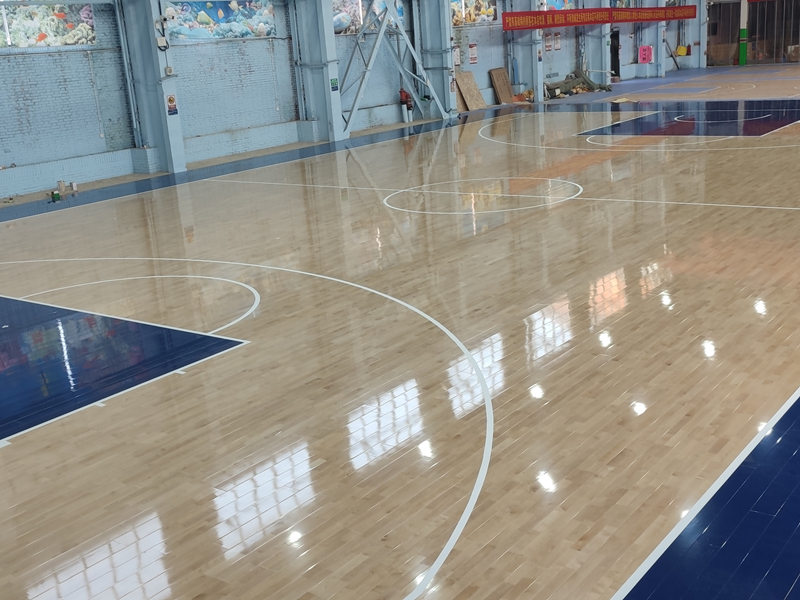
Introduction
While the gleaming, polished hardwood surface of a basketball court receives all the attention from spectators and television cameras, the true magic of a portable sports floor happens beneath the surface. The performance, safety, and structural integrity of a temporary court are entirely dependent on its structural anatomy—specifically, the subfloor underlayment and the interlocking systems that connect individual panels. A portable court must function as a single, cohesive unit, despite being composed of hundreds of individual pieces. Understanding the complex layering and mechanical hardware that make this possible is essential for anyone involved in sports facility management, athletic coaching, or event production.
The Layered System: From Concrete to Court Surface
A high-performance portable basketball court is not merely wood laid over concrete; it is a highly engineered, floating, multi-layer sandwich system. Each layer has a specific function designed to optimize playability, distribute loads, and protect the athletes.
The Substrate and Moisture Barrier
The bottom-most layer is the host facility's permanent floor, which is typically concrete, synthetic turf, or an ice rink surface covered with insulated panels. Before the portable court is installed, a heavy-duty poly vapor barrier (usually 6-mil polyethylene sheeting) is laid down. This layer is crucial because it prevents moisture from migrating from the concrete or ice up into the wooden floor system, which would cause the wood to warp, cup, or swell.
Elastomeric Resilient Pads
Positioned directly above the vapor barrier (or integrated into the underside of the floor panels) are the resilient pads. These pads are the primary source of the floor’s shock absorption and vibration damping. Usually made of natural rubber, neoprene, or high-density polyurethane foam, these cushions are engineered with specific shapes and densities. Some are hemispherical "conical" pads, while others are continuous foam strips. When an athlete lands, these pads compress, reducing the force transmitted back up into the player’s legs. The spacing and pattern of these pads are precisely calculated to ensure that every square inch of the court has the same amount of "give," preventing hard zones and dead spots.
The Subfloor Core
Above the resilient pads lies the subfloor core, which provides the structural backbone of the individual panels. In professional portable systems, this core typically consists of two layers of high-quality APA-rated plywood, cross-laminated and securely fastened together. This cross-lamination is vital because it neutralizes the natural tendency of wood to expand and contract along the grain, ensuring that each 4x8-foot panel remains perfectly flat and dimensionally stable. The thickness of this plywood core typically ranges from 1/2 inch to 3/4 inch, providing the necessary strength to support heavy rolling loads, such as arena cleaning equipment and portable basketball goals.
The Maple Face Layer
The topmost layer is the tongue-and-groove solid Northern Hard Maple. These planks are typically stapled or nailed to the plywood subfloor core. The maple is milled with high-precision tongue-and-groove profiles on both the sides and ends, ensuring a tight, interlocking fit between the individual boards within each panel.
Interlocking Mechanics: Connecting the Puzzle
The most significant engineering challenge of a portable court is ensuring that the individual panels remain locked together as a single, immovable surface during intense athletic competition. If the panels drift apart, even by a fraction of an inch, it can create dangerous gaps, uneven surfaces, and inconsistent ball bounce. To prevent this, manufacturers have developed sophisticated, heavy-duty interlocking systems.
Pin-and-Loop Systems
One of the most common and reliable interlocking methods is the pin-and-loop system. Along the long edges of each panel, high-tensile steel pins are recessed into the subfloor, while corresponding steel loops or brackets are mounted on the opposite edge of the adjacent panel. During installation, the panels are laid down in a staggered, brick-like pattern. As one row of panels is slid into place beside the next, the steel pins engage with the loops, securing the panels horizontally and vertically. This system is highly favored because it is incredibly fast to assemble and disassemble, requiring no specialized tools to lock the panels together.
Latching and Zipper Systems
Another popular interlocking mechanism involves integrated latching systems, often referred to as cam-locks or rotary latches. These systems feature a rotating latch mechanism embedded within the subfloor of one panel and a corresponding strike plate in the adjacent panel. Once two panels are aligned, an installation technician inserts a specialized T-handle hex wrench into a small, inconspicuous access hole on the surface of the floor. Turning the wrench rotates the internal cam-lock, pulling the two panels tightly together with hundreds of pounds of clamping force. This "zipper" method creates an exceptionally tight, seamless joint and allows for micro-adjustments during installation to ensure absolute flatness.
Staggered Brick Patterning
To further enhance structural stability, portable courts are always installed in a staggered brick pattern. This means that the short joints of the panels in one row do not align with the short joints in the adjacent rows. By offsetting these joints, the floor distributes lateral forces across multiple panels rather than allowing a continuous seam to flex under load. This staggered layout mimic the structural benefits of traditional brick masonry, significantly increasing the overall shear strength of the playing surface.
Edge Constraints and Perimeter Transitions
A floating floor system must be secured at its perimeter to prevent the entire court from sliding across the facility's subfloor. Portable courts achieve this through specialized perimeter ramping and anchoring systems. Heavy-duty steel transition ramps are attached to the outer edges of the court. These ramps serve two critical purposes: they provide a safe, gradual incline for athletes running off the court and for rolling equipment, and they lock the outer boundary of the court into place. In some setups, the perimeter ramps are anchored directly to the concrete floor via recessed expansion bolts, ensuring that the entire 94x50-foot assembly remains absolutely stationary throughout the game.
Conclusion
The structural anatomy of a portable indoor basketball court wood floor is a brilliant integration of physics, materials science, and mechanical engineering. By combining moisture barriers, resilient elastomeric pads, dimensional plywood cores, and precision interlocking hardware, engineers have created a modular system that performs with the same structural unity and athletic excellence as a permanent installation. For venue operators, understanding this internal anatomy highlights the importance of proper handling, maintenance, and storage, ensuring that these complex engineered systems continue to provide safety and high performance for athletes over their operational lifespan.
Leave a Reply