

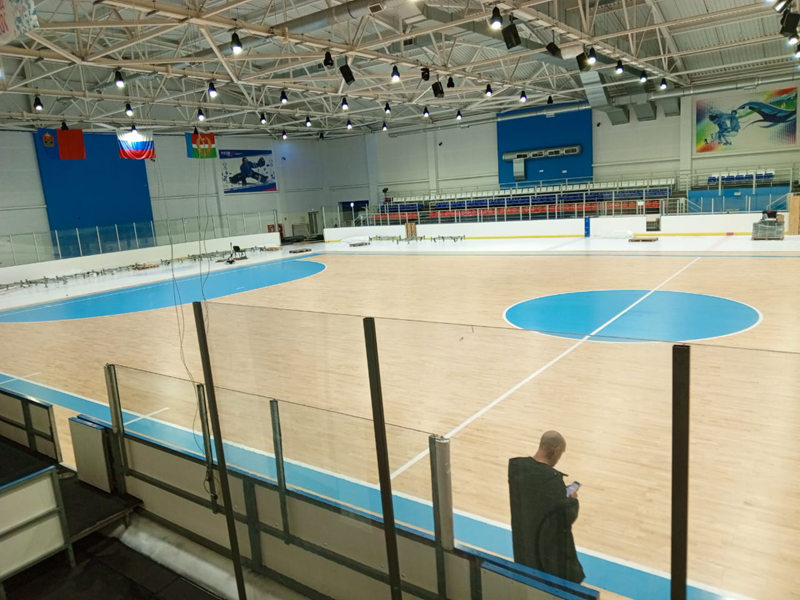
Introduction
The choice of wood species and the quality of raw materials are the foundational pillars of any premium portable sports flooring system. While the structural underlayment and interlocking mechanisms dictate how a portable court behaves as a system, the visible wood surface—the face layer—directly interacts with the athletes, the basketball, and the environment. Because portable courts are subjected to repeated assembly, disassembly, transport, and varying storage conditions, the raw materials must possess exceptional stability, durability, and resilience. This article explores the physical properties, grading standards, and material considerations that guide the selection of wood species for portable indoor basketball court flooring.
The Dominance of Northern Hard Maple
In the world of basketball, Northern Hard Maple (Acer saccharum) is widely recognized as the gold standard. There are several scientific and practical reasons why this specific hardwood dominates the sports flooring industry, particularly for high-end portable courts.
High Density and Janka Hardness
Northern Hard Maple possesses an ideal balance of hardness and elasticity. On the Janka hardness scale, which measures the resistance of a wood species to denting and wear, Northern Hard Maple ranks at approximately 1,450 pounds-force (lbf). This high density ensures that the floor can withstand the intense, repetitive impacts of basketball shoes, dropped equipment, and the heavy rolling loads of portable goal systems without gouging or denting. At the same time, maple is not so hard that it feels like concrete; it retains a natural microscopic flexibility that contributes to the overall shock absorption of the system.
Dense, Closed Grain Structure
Unlike open-grained hardwoods like Oak or Ash, Northern Hard Maple has a tight, closed grain structure. This physical characteristic is highly beneficial for sports applications. A closed grain prevents dirt, sweat, and moisture from easily penetrating the wood fibers, making the court much easier to clean and maintain. Furthermore, the absence of deep, open grain lines prevents splintering, which is a critical safety consideration for athletes sliding across the court.
Aesthetic Contrast and Light Reflection
From a visual perspective, Northern Hard Maple offers a light, uniform color ranging from creamy white to light reddish-brown. This light coloration is highly valued by broadcasters, spectators, and players because it reflects light exceptionally well. High light reflectance enhances visibility on the court, reduces shadows, and provides an excellent background for painted court lines, team logos, and television broadcasts.
Grading Standards for Hard Maple
Hard maple flooring is classified into different grades established by official wood manufacturing associations. These grades are determined based on visual characteristics and the presence of natural variations, such as knots, streaks, and color differences. Understanding these grades is crucial when specifying materials for a portable court.
First Grade Maple
First Grade is the highest quality available. It features an almost completely uniform, light creamy white appearance with minimal natural color variations. This grade allows virtually no knots, mineral streaks, or bird’s-eye blemishes. It is the preferred choice for professional and major collegiate basketball courts, where absolute visual uniformity and maximum light reflection are required for high-definition television broadcasts.
Second Grade Maple
Second Grade maple allows for moderate color variations, sound knots, and light mineral streaks. This grade exhibits a more natural, character-rich appearance, combining the light sapwood with darker heartwood. While it lacks the pristine uniformity of First Grade, Second Grade maple offers identical physical performance and durability. It is frequently selected for practice facilities, high schools, and multi-purpose community centers due to its excellent balance of performance and cost-effectiveness.
Third Grade Maple
Third Grade maple features significant natural color variations, prominent mineral streaks, and sound knots of various sizes. It has a highly rustic appearance. While the mechanical performance is still excellent, Third Grade maple is rarely used for primary competition basketball courts because the busy visual patterns can interfere with the visibility of court markings and logos. However, it is an excellent, economical option for general recreational spaces and storage-heavy utility areas.
Alternative Wood Species in Sports Flooring
While Northern Hard Maple is the undisputed leader in North America, other wood species are utilized in different parts of the world or for specific aesthetic and budgetary requirements.
European Beech (Fagus sylvatica)
In Europe, Beech is a highly popular alternative to Maple. Beech possesses a fine, even structure with a warm, reddish-brown hue. It has a Janka hardness rating comparable to maple (around 1,300 to 1,400 lbf) and offers excellent shock-absorbing capabilities. However, Beech is highly sensitive to fluctuations in relative humidity, meaning it expands and contracts more than maple when exposed to moisture. For a portable court, which may travel through diverse climates, this hygroscopic sensitivity requires strict climate control during transport and storage.
European Oak (Quercus robur)
Oak is occasionally used for sports courts, particularly where a highly traditional, classic look is desired. Oak is highly durable and possesses a rich, prominent grain pattern. However, because Oak is an open-grained wood, it requires extensive sealing to prevent dirt accumulation and splintering. Additionally, its strong grain patterns can make court lines more difficult to see compared to the uniform surface of maple.
Birch (Betula pendula)
Birch is a softer hardwood, with a Janka hardness rating of around 1,260 lbf. It features a light color similar to maple but is more susceptible to denting under heavy loads. Birch is typically used in entry-level or light-use recreational portable courts where budget is the primary constraint.
Engineered Wood vs. Solid Wood in Portable Systems
A critical design decision in portable sports floors is whether to use solid wood planks or engineered wood panels for the face layer.
Solid wood flooring consists of solid planks of hardwood, typically 25/32 inches or 33/32 inches thick. Solid wood offers the longest lifespan because it can be sanded and refinished multiple times over several decades. However, solid wood is more prone to expanding and contracting with changes in humidity, which can lead to warping or cupping if environmental controls fail.
Engineered wood flooring consists of a real hardwood veneer (usually 3mm to 6mm thick) bonded to a multi-ply plywood or high-density fiberboard (HDF) core. Because the core layers are glued in alternating grain directions, engineered wood is extremely stable dimensionally. It is far less susceptible to moisture-induced movement, making it highly attractive for portable courts that are frequently transported between different venues with unpredictable climates. The trade-off is a shorter overall lifespan, as engineered wood can only be sanded a limited number of times before wearing through the hardwood veneer.
Conclusion
The material composition of a portable indoor basketball court wood floor is a science of balance. Northern Hard Maple remains the premier choice due to its high hardness, closed grain, and superior light reflection. However, the choice between solid and engineered configurations, as well as the specific grade of wood selected, must be carefully aligned with the venue's operational needs, climate challenges, and financial parameters. Investing in high-grade, structurally sound materials ensures that the temporary court will perform flawlessly and protect athletes for many years to come.
Leave a Reply