

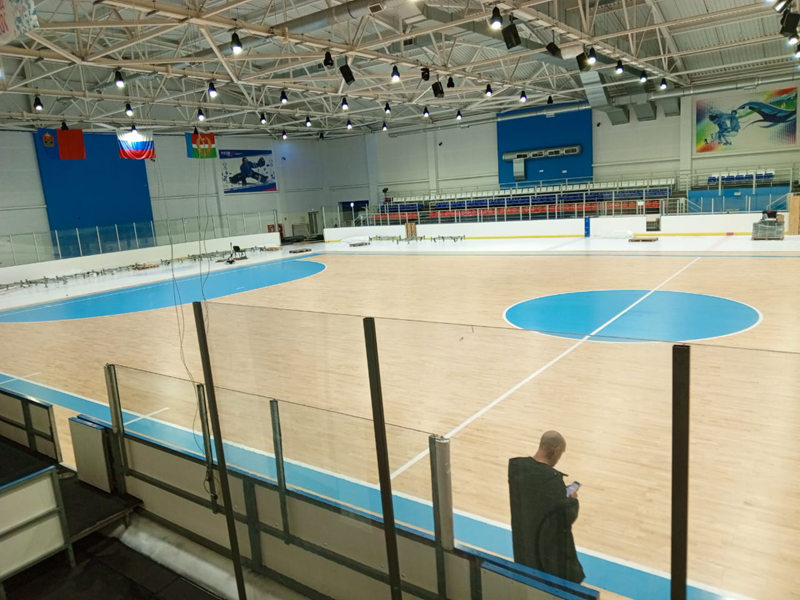
Installing a portable indoor basketball court wooden flooring system is significantly simpler than installing permanent hardwood, but it still requires careful planning and execution to ensure optimal performance. Following a systematic approach prevents common mistakes that can compromise playability and longevity.
Step one is site preparation. The existing floor must be clean, dry, level, and free of debris. Even though portable systems are designed to sit on top of existing floors, an uneven surface will cause the panels to shift, create gaps, and reduce shock absorption effectiveness. Use a long straightedge to check for high and low spots. Any deviation greater than 3mm over 3 meters should be corrected. For concrete floors, a self-leveling compound may be necessary. For existing wood or tile floors, ensure there are no loose boards or cracked tiles that could create pressure points.
Step two is acclimatization. Wood is a natural material that expands and contracts with temperature and humidity changes. Even engineered wood needs time to adjust to the environment where it will be installed. Allow the panels to sit in the installation room for at least 48 hours before installation. Ideally, the temperature should be between 18°C and 25°C, and relative humidity between 40% and 60%. Skipping this step can lead to warping, cupping, or gaps after installation.
Step three is layout planning. Measure the room carefully and plan the panel orientation. Most portable basketball courts are laid with the wood grain running parallel to the sidelines (lengthwise), which provides the most consistent ball bounce. Mark the starting point and ensure you have enough space for the full court dimensions including any border or out-of-bounds area. It is better to center the court in the room with equal margins on all sides than to push it against one wall.
Step four is panel installation. Begin from one corner and work systematically across the room. For interlocking systems, align the tongue of one panel with the groove of the previous panel and press firmly until you hear or feel the click. For click-lock systems, angle the panel at approximately 30 degrees and press down until it snaps into place. For floating tile systems, simply lay each tile in position. Do not force panels — if they do not fit easily, check for debris or misalignment.
Step five is border and edge treatment. Most portable systems include edge pieces or transition strips to create a clean border. Install these after all main panels are in place. Use a rubber mallet to tap edges into position without damaging the wood surface.
Step six is final inspection. Walk the entire court and check for any gaps, uneven panels, or loose connections. Test the ball bounce in several locations to ensure consistency. If any panel feels different from the others, lift and reseat it.
The entire process for a standard full-size court typically takes four to eight hours with a team of two to four people. No special tools are required beyond a rubber mallet, a utility knife for trimming, and a tape measure.
Leave a Reply