

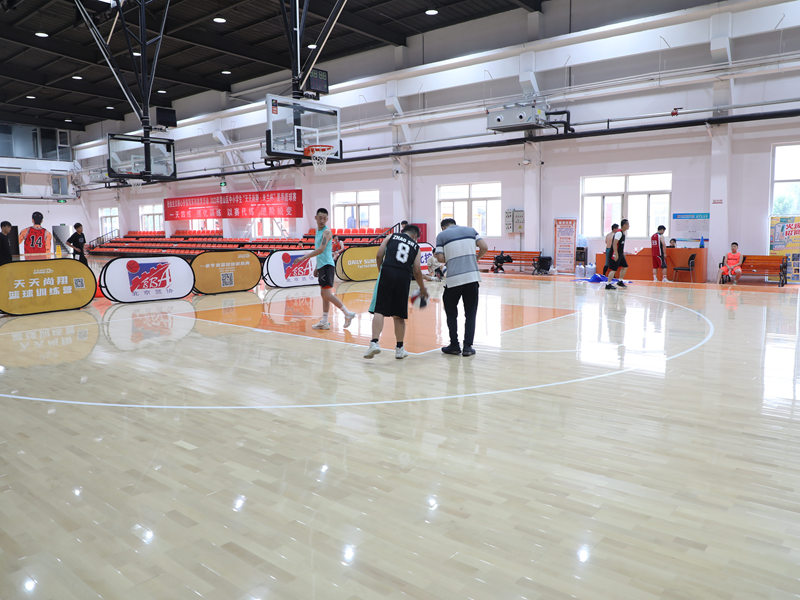
No matter how well you maintain your basketball court hardwood floor, there will come a time when it needs to be refinished. The finish will wear down, the surface will become scuffed and dull basketball court floor system typically ranges from 20 to 25 millimeters, and every millimeter matters.
In this article, we will break down the thickness specifications of each component of a basketball court hardwood floor and explain why each layer is the thickness it is.
The Hardwood Plank: 18 to 20 Millimeters
The top layer — the part you see and play on — is the hardwood plank itself. For basketball courts, the standard thickness is 18 to 20 millimeters (approximately 3/4 inch). This thickness is specified by every major basketball organization in the world.
Why 18 to 20 millimeters? Thinner planks (such as the 12 to 15 millimeter planks used in residential flooring) are not suitable for basketball courts because they lack the mass and stability needed for consistent ball bounce. A thinner plank will flex more under impact, causing the ball bounce to vary from one area to another.
Thicker planks (22 millimeters or more) are unnecessary and add cost without improving performance. The 18 to 20 millimeter range is the sweet spot.
The width of the planks is also specified. For professional courts, the standard width is 70 to 75 millimeters. Wider planks (such as the 90 to 100 millimeter planks used in some residential applications) are not used in basketball because they can create more visible seams, which can affect ball bounce and aesthetics.
The Underlayment: 6 to 12 Millimeters
Beneath the hardwood planks is the underlayment layer. This is typically made of foam. This is why every professional league specifies strict standards for ball bounce.
The Official Standard
According to the regulations set by the International Basketball Federation (FIBA) and the National Basketball Association (NBA), a ball dropped from a height of 1.8 meters should bounce back to a height between 1.2 and 1.4 meters. This is a bounce ratio of 67 to 78 percent.
The variation in bounce height across the entire court must not exceed 10 millimeters. In other words, if the ball bounces to 1.3 meters in one spot, it must bounce to between 1.29 and 1.31 meters in any other spot on the court. This is an incredibly tight tolerance, and it is what separates a professional-quality floor from a recreational one.
What Affects Ball Bounce Consistency?
Several factors affect ball bounce consistency:
Floor flatness: If the floor is not perfectly flat, the ball will bounce higher on high spots and lower on low spots. This is why subfloor preparation and leveling are so critical.
Plank alignment: If planks are not perfectly aligned, small ridges or gaps at the seams can affect the ball's bounce. Staggered installation with tight seams is essential.
Wood density: Different pieces of wood have slightly different densities, which can affect bounce. This is why high-quality floors use wood from the same batch or lot, ensuring uniform density.
Finish thickness: If the finish is applied unevenly, it can create areas of different hardness that affect bounce. Multiple thin coats with sanding between each alternating directions, creating a woven pattern. This was another popular design in the mid-20th century.
Parquet: Small blocks of wood are arranged in geometric patterns. This is the most ornate design and is typically found in historic arenas.
While straight lay is the most common today due to its simplicity and consistency, many facilities still choose herringbone or parquet for their visual impact. These patterns add character and create a sense of tradition.
Court Markings and Color Contrast
The court markings are an essential part of the visual design. The standard colors are white for the lines on a natural wood floor, though some courts use black or colored lines for contrast.
The contrast between the lines and the floor is critical. On a light maple floor, white lines provide excellent contrast. On a darker floor (such as stained oak), white or light-colored lines are essential.
The center court logo is another opportunity for visual impact. Many arenas feature elaborate logos inlaid into the floor, using contrasting wood species or colors. These logos become iconic symbols of the team and the arena.
Lighting and Visual Impact
The way light interacts with the floor is a crucial aesthetic factor. A well-finished hardwood floor reflects light in a warm, inviting way. The finish should be satin — not too glossy, which creates glare, and not too matte, which looks dull.
Arena lighting is designed to illuminate the court evenly, minimizing shadows and glare. The combination of proper lighting and a well-finished floor creates a visual experience that is stunning on television acoustic environment that is comfortable for players, coaches, and spectators alike.
Leave a Reply