

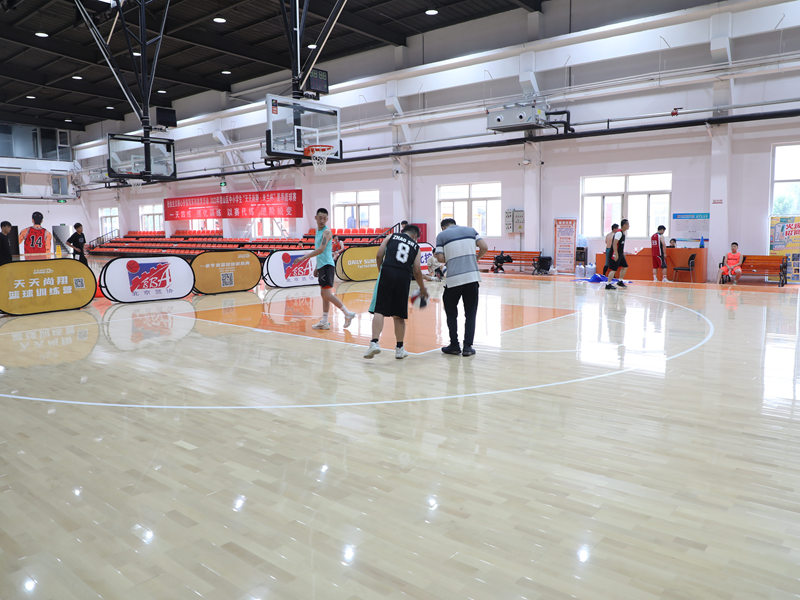
Raw material quality determines the upper limit of indoor basketball court wood flooring service life, and Naibu has established ultra-strict global timber procurement and screening standards that distinguish it from cost-cutting low-end floor manufacturers. The brand only cooperates with certified sustainable forest bases in North America and Europe, strictly limiting the log varieties used for basketball court wood flooring to hard maple and high-grade birch, completely rejecting low-density softwood, mixed-grade lumber and timber from unregulated logging sources. Every batch of raw wood undergoes multi-dimensional testing before entering the production line, covering moisture content, hardness, grain uniformity, internal crack detection and environmental safety indicators, ensuring zero unqualified materials flow into finished panel production.
For hard maple, Naibu’s primary surface panel material, the brand exclusively selects FAS top-grade logs, the highest classification of hardwood lumber. FAS-grade maple features fine, compact grain, consistent density and almost no large knots or mineral streaks, which directly guarantees uniform ball bounce and flat surface traction. The Janka hardness value of Naibu’s selected maple reaches 1450, stronger than ordinary oak, enabling the floor to withstand tens of thousands of daily foot strikes, frequent dribbling impact and heavy equipment placement without permanent dents or surface scratches. Lower-grade maple lumber contains scattered loose grain and soft spots; after several years of high-intensity use, local areas will show dull ball bounce and uneven friction, affecting athletes’ judgment and increasing sports injury risks.
Moisture control is the core link of Naibu’s timber preprocessing. All logs enter a closed gradient kiln drying workshop for 21 to 35 days of slow temperature and humidity adjustment, gradually reducing wood moisture to a fixed equilibrium range of 6% to 9%. Fast high-temperature drying adopted by cheap floor brands creates massive internal stress inside wood fibers; after installation, seasonal humidity fluctuations will trigger severe panel warping, edge cupping and cracking. Naibu’s slow drying process eliminates internal tension completely, locking stable dimensional performance into each plank before panel forming, greatly reducing expansion and contraction deformation after paving. Automated optical scanning equipment inspects every dried lumber piece, automatically screening out planks with hidden microcracks and uneven density that cannot be identified by naked eyes.
Auxiliary structural materials also follow Naibu’s unified high-standard procurement system. The balance plywood between keels and surface panels uses multi-layer cross-laminated waterproof plywood, with each veneer bonded by eco-friendly zero-formaldehyde resin glue. Unlike ordinary plywood that uses cheap industrial glue with excessive formaldehyde release, Naibu’s plywood passes CNAS environmental testing, with volatile organic compound emissions far below international indoor venue limits, safe for children and athletes who stay on the court for hours daily. Shock-absorbing cushions are imported closed-cell elastic materials customized for Naibu, free of recycled waste rubber and harmful plastic additives, avoiding unpleasant chemical odors inside closed gyms.
Naibu implements six-sided full sealing treatment for every finished wood panel during manufacturing, a process dependent on high-quality waterproof primer matched with premium timber. The cross-linking resin primer penetrates deep into wood pores of maple and birch planks, forming an all-round moisture lock on the front, back and four edges of each panel. Brands that only coat the bottom of planks leave edge and top grain porous; sweat, spilled sports drinks and humid air continuously invade wood fibers through seams, causing mildew, discoloration and swelling within a few years. Naibu’s complete sealing technology complements stable raw timber performance, maximizing the natural dimensional stability of premium maple and birch.
The brand’s raw material traceability system further guarantees consistent quality across all Naibu basketball court wood flooring projects. Each batch of timber is labeled with unique procurement serial numbers, recording forest origin, felling time, drying cycle and inspection data. If any performance deviation occurs after installation, technicians can quickly trace back to raw material links for analysis and optimization. For venue operators, strict raw material standards mean fewer post-installation maintenance troubles, longer service cycles and no need for frequent partial panel replacement caused by inferior lumber defects. Whether customers choose standard birch series for medium-traffic training venues or premium hard maple series for professional competition arenas, every piece of Naibu basketball court wood flooring raw material adheres to the same rigorous screening rules, eliminating quality differentiation between product lines.
Leave a Reply