

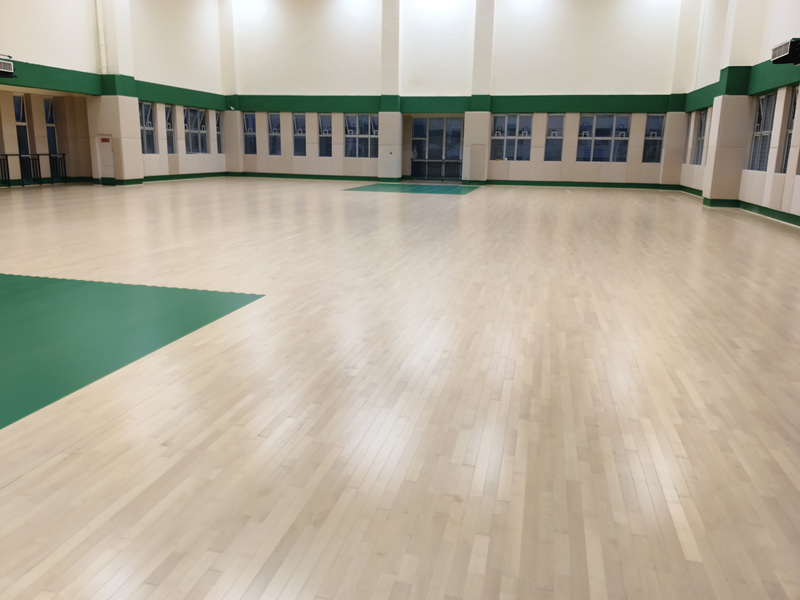
The biggest hidden danger of indoor basketball venues lies in joint injuries caused by insufficient floor impact buffering. Continuous jumping, hard landings and sharp lateral movements transmit huge vertical force from the court surface to athletes’ knees, ankles and spines; unqualified basketball court wood flooring fails to absorb this energy, leading to chronic tendon inflammation, stress fractures and frequent sprains for amateur and professional players alike. Naibu designs every layer of its basketball court wood flooring around scientific athlete protection, developing graded multi-stage shock absorption technology that disperses impact force step by step and drastically lowers long-term sports injury risks for all age groups.
The core shock absorption logic of Naibu basketball court wood flooring relies on layered energy dissipation from bottom elastic cushions to surface maple panels. When an athlete lands heavily after a jump, the closed-cell shock pads at the bottom bear the primary impact load, compressing moderately to absorb over 40% of vertical force. The solid wood keel layer evenly distributes residual impact across the entire floor structure, avoiding concentrated pressure on single panels. The hard maple surface layer provides mild surface buffering to reduce instant friction shock during foot contact. Laboratory impact testing shows Naibu’s complete floor system achieves a shock absorption rate of 55% to 62%, comfortably surpassing the FIBA mandatory minimum of 53%. Floors below this standard transmit more than half of landing force back to players’ bodies; long-term training on such hard surfaces will inevitably cause cumulative joint damage.
Controllable vertical deflection is another injury-prevention breakthrough of Naibu basketball court wood flooring. FIBA limits maximum floor deflection under load to 2.3mm—too much deflection creates a spongy, unresponsive surface that slows players’ explosive movements, while insufficient deflection removes vital buffer protection. Naibu’s engineering team adjusts keel thickness and shock pad density according to venue positioning: youth training venues adopt slightly softer elastic configurations with controlled deflection close to 2.3mm to cushion falls for kids with weak joint structures, while professional competition floors fine-tune rigidity to balance shock absorption and energy return for elite athletes’ fast sprints and jumps. This targeted adjustment avoids the one-size-fits-all rigid structure of generic floor brands, realizing differentiated safety protection for different player groups.
Optimized surface traction of Naibu basketball court wood flooring prevents ankle sprains caused by slippery or overly sticky floors, a common injury source during cross-overs, defensive slides and jump stops. The brand’s factory UV high-gloss paint film distributes micro wear-resistant particles evenly, maintaining a permanent friction coefficient between 0.4 and 0.6, the globally recognized safe range for basketball. Sweaty or liquid-spilled surfaces will not lose traction rapidly, as the dense non-porous paint repels liquid penetration; quick mopping restores standard grip within minutes. Low-cost on-site painted floors lose uniform friction after several months of wear: partial areas become slippery while others catch sneaker soles, triggering sudden twisting injuries during rapid direction changes. Naibu’s wear-resistant paint film retains stable traction performance for 8 to 12 years before requiring professional refinishing, continuously eliminating slip hazards throughout the floor’s service life.
Seamless large-format panel design eliminates tripping risks that lead to accidental falls. Ordinary narrow planks create dense splicing gaps with protruding edges that catch sneaker toe caps during fast gameplay. Naibu’s 2400mm ultra-long wide panels cut seam quantity by over 85%, forming a nearly continuous flat playing surface. The patented tenon-and-mortise interlocking joints lock panels tightly together, preventing individual planks from lifting or sinking under heavy traffic. Even after decades of daily use, the floor surface maintains flatness within 2mm error per two-meter ruler, removing uneven protrusions that cause trips and falls during intense matches and training.
Environmental safety indirectly protects athletes’ long-term physical health, an easily overlooked safety dimension fully covered by Naibu basketball court wood flooring. All raw timber comes from sustainable certified forests without illegal deforestation lumber; UV curing paint produces zero volatile toxic gas emissions during production, with no formaldehyde or heavy metal additives in glue and coating materials. For youth basketball training centers where children spend several hours daily on the court, Naibu’s zero-pollution floor system avoids respiratory irritation and allergic reactions caused by chemical emissions from inferior sports floors. Every finished Naibu basketball court wood flooring batch passes third-party environmental testing, providing venue operators with complete eco-safety certification documents for venue inspection and opening approval.
From casual student players to professional league athletes, Naibu basketball court wood flooring integrates multi-dimensional injury prevention design into every structural layer, turning a simple playing surface into a scientific protective barrier for human joints. Thousands of Naibu venue clients report obvious reductions in player ankle and knee sprain incidents after replacing old low-grade floors with Naibu systems, proving the practical safety value of the brand’s shock absorption and surface optimization technology in real daily venue operation.
Leave a Reply