

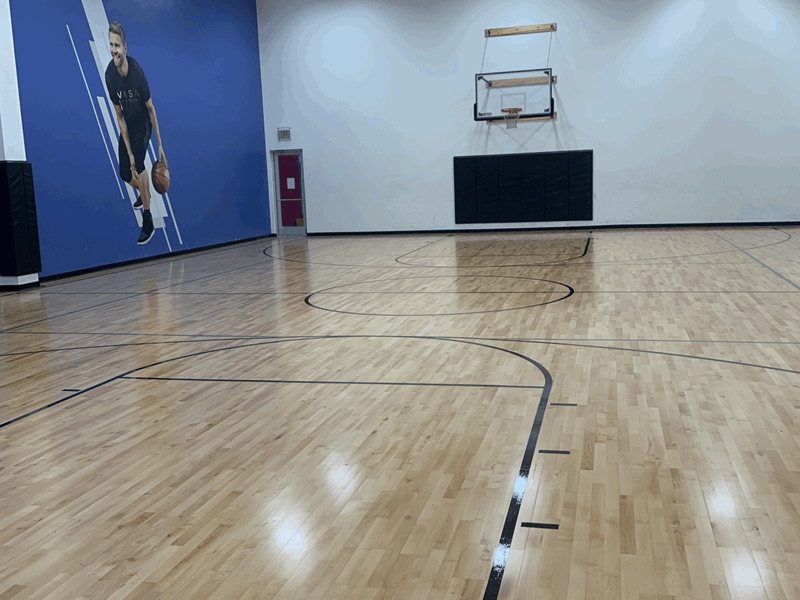
Performance is the reason players, coaches, and facility managers care about flooring in the first place. A beautiful floor that performs poorly is worthless on a basketball court. Fortunately, modern portable basketball court wood flooring has reached a level of performance that satisfies even demanding users. Let us examine the key performance characteristics.
Ball bounce is the most visible performance metric. Official basketball rules specify that a ball dropped from a height of 1.8 meters should bounce back to a height between 1.2 and 1.4 meters. This requires a surface with the right combination of hardness and elasticity. High-quality portable flooring uses a hardwood core, typically maple or oak, with a thickness of 20mm or more, to achieve bounce values within this range. The surface finish also plays a role; a matte or semi-gloss finish provides more consistent friction than a high-gloss finish, which can cause the ball to skid.
Shock absorption is critical for player health. Hard surfaces transmit impact forces directly to the joints, increasing the risk of knee, ankle, and hip injuries. Portable flooring systems address this through a combination of material selection and subfloor design. Thicker panels absorb more impact. Some systems incorporate a foam or rubber underlayment beneath the wood panels to add an extra layer of cushioning. The goal is to achieve a vertical deformation of at least 2.3mm under a standard load, which is the threshold recommended by most sports governing bodies.
Surface friction determines how well players can stop, start, and change direction. Too little friction and players slip. Too much friction and they cannot move quickly. The ideal coefficient of friction for a basketball court is between 0.4 and 0.6. Portable wood flooring achieves this through its surface finish and the natural texture of the hardwood. Regular cleaning is essential to maintain friction levels, as dust and dirt can either increase or decrease friction unpredictably.
Flatness and consistency across the entire court surface are essential for fair play. Any panel that sits higher or lower than its neighbors creates an uneven playing surface that affects ball behavior and player safety. High-quality portable systems use precision-milled edges and robust connection systems to maintain flatness even after dozens of assembly and disassembly cycles. Check flatness regularly using a straightedge, and address any deviations immediately.
Energy return is a more subtle but important characteristic. It refers to how much of the player's energy is returned by the surface rather than absorbed. A floor with good energy return feels lively and responsive, reducing fatigue over the course of a game. Hardwood cores with high density provide the best energy return. Engineered alternatives can approximate this but may feel slightly less responsive underfoot.
Temperature stability affects performance in extreme conditions. Wood expands in heat and contracts in cold. In outdoor settings, this can cause panels to gap in summer and buckle in winter. Modern portable systems mitigate this through moisture-resistant treatments, expansion gaps at the perimeter, and connection systems that allow for slight movement without compromising flatness.
When all these characteristics are optimized, portable basketball court wood flooring delivers a playing experience that is genuinely excellent. The gap with permanent courts has narrowed to the point where performance is rarely the deciding factor in choosing between them.
Leave a Reply