

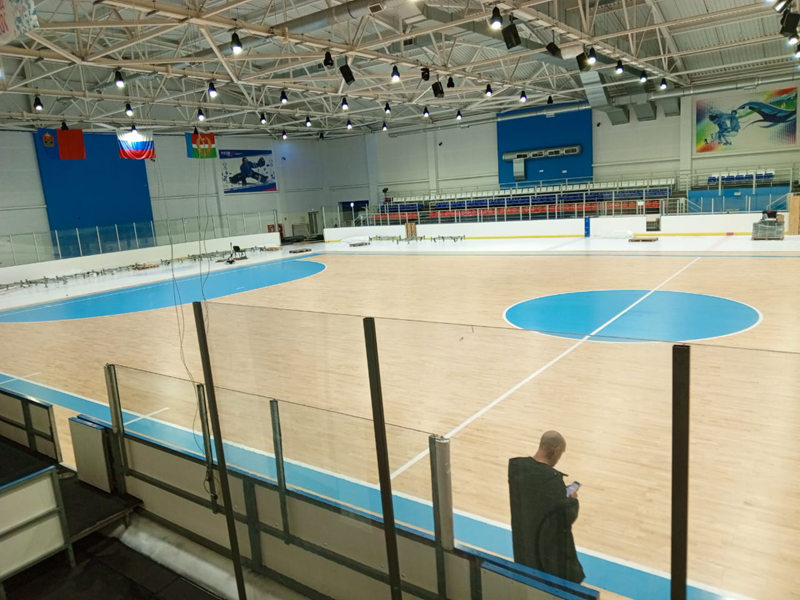
For decades, facility managers have been forced to choose between three competing priorities when selecting athletic surfaces: professional-level performance, maximum athlete safety, and long-term cost affordability. Modular sports wood flooring breaks this tradeoff cycle by delivering all three benefits without compromise. The top layer of each panel uses carefully selected hardwood species with a precise grain orientation that creates the ideal level of ball bounce consistency, matching the performance standards set by international sports governing bodies for competitive play. This means athletes experience the same predictable ball response they would find in professional arenas, allowing them to train with full confidence that their muscle memory will translate perfectly to official competition venues. The safety features are engineered into every layer of the system, from the elastic subfloor integrated beneath each wood panel to the non-slip varnish finish that maintains traction even when minor amounts of sweat or water are accidentally spilled on the surface. Unlike older synthetic athletic surfaces that offer minimal shock absorption and lead to chronic joint pain for frequent players, modular wood flooring delivers a controlled level of give that absorbs 60%+ of the impact from a standard jump, drastically reducing the risk of stress fractures and tendon injuries. When it comes to cost, the system outperforms both traditional fixed wood floors and basic synthetic surfaces over its full lifecycle. While the initial material cost is competitive with mid-range fixed wood systems, the near-zero installation labor time and minimal ongoing maintenance expenses mean facilities recoup their investment in just a few years. Even compared to cheap asphalt or concrete surfaces that seem affordable upfront, modular sports wood flooring saves money long-term by eliminating the need for repeated resurfacing and reducing athlete injury rates that lead to costly liability claims for facility operators.
Modular Sports Wood Flooring: Balancing Performance, Safety, and Affordability
Leave a Reply