

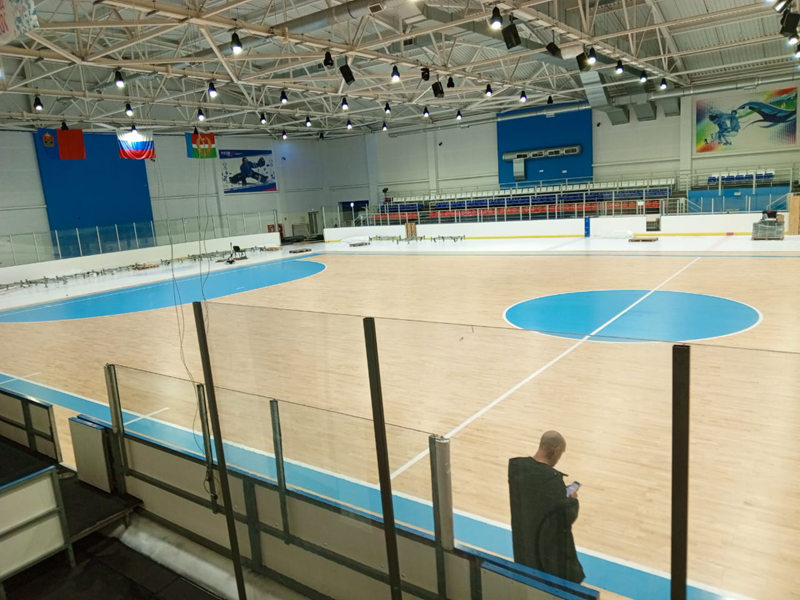
One of the most common debates in the world of indoor basketball court flooring is whether to go with interlocking wooden flooring or traditional solid hardwood. Both options have their merits, but when you examine the key factors that matter most for a basketball court, the differences become clear. This article provides a detailed comparison to help you understand which option is right for your needs.
Let us start with installation. Solid hardwood flooring is installed using nails, staples, or glue. The process requires a perfectly flat subfloor, acclimatization of the wood to the environment, and multiple coats of finish applied over several days. A professional crew can take one to two weeks to complete a standard court. Interlocking flooring, on the other hand, requires no glue, no nails, and no acclimatization period. The panels simply click together, and the court can be ready in a matter of days. For any project where time is a factor, interlocking is the clear winner.
Next, consider performance. Solid hardwood provides an excellent playing surface with great ball bounce and traction. However, it offers very little shock absorption on its own. To make solid hardwood suitable for basketball, you must install a separate underlayment or spring system beneath it, which adds cost and complexity. Interlocking wooden flooring incorporates shock absorption directly into the panel design. The base layer of each panel is made from materials like polypropylene honeycomb or rubber, providing consistent cushioning across the entire court without any additional components.
Durability is another area where the two systems differ significantly. Solid hardwood is a single continuous surface. If one section gets damaged, you may need to sand and refinish a large area, or in severe cases, replace entire boards. This is a time-consuming and expensive process. With interlocking flooring, each panel is independent. If one panel is scratched, dented, or stained, you simply lift it out and replace it with a new one. The rest of the court remains untouched. This modular durability is a massive advantage in a high-traffic environment like a basketball court.
Cost is always a consideration. Solid hardwood, including materials and professional installation, tends to be more expensive upfront. The cost of the subfloor preparation, the underlayment, the finishing, and the labor all add up. Interlocking flooring has a comparable material cost, but the installation cost is dramatically lower because it does not require skilled carpenters. Over the lifetime of the floor, interlocking also tends to be cheaper because repairs are simpler and less frequent.
Flexibility is perhaps the most decisive factor. Solid hardwood is permanently attached to the subfloor. If you need to move the court, convert the space to another use, or even just access the subfloor for repairs, you are looking at a major demolition project. Interlocking flooring can be disassembled panel by panel and reassembled elsewhere. This makes it ideal for schools, community centers, and any facility where the space may need to serve multiple purposes.
In summary, while solid hardwood has a certain traditional appeal, interlocking wooden flooring offers superior performance, easier installation, better durability, lower long-term cost, and unmatched flexibility for indoor basketball courts. For most applications, it is the smarter choice.
Leave a Reply