

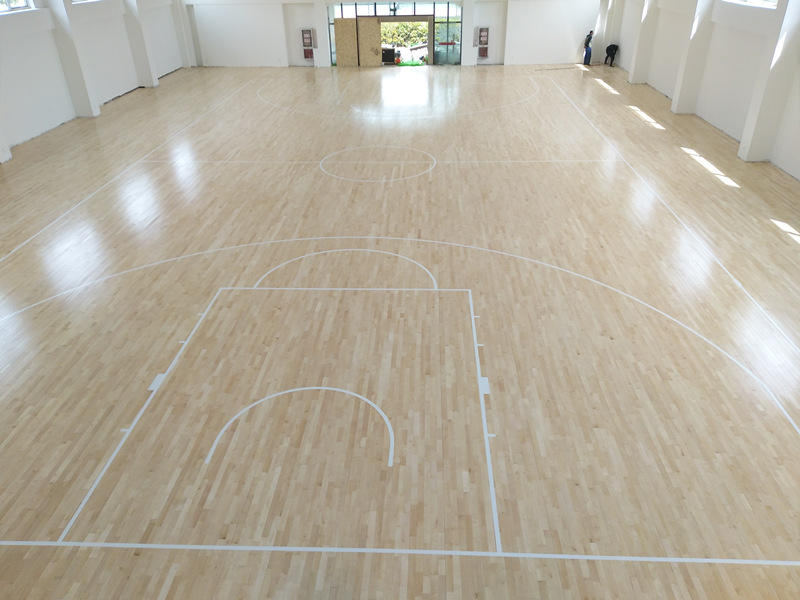
Installing an interlocking wooden floor for an indoor basketball court is a project that can be completed with the right preparation and a methodical approach. While it is far simpler than installing traditional hardwood, there are still important steps you must follow to ensure the final result is level, stable, and performs as expected. This article walks you through the entire installation process from start to finish.
The first step is subfloor preparation. This is the most critical phase of the entire installation. The subfloor must be clean, dry, flat, and structurally sound. If you are installing over concrete, check for moisture by taping a plastic sheet to the floor and leaving it for 24 hours. If condensation appears underneath, you have a moisture problem that must be addressed before proceeding. Any cracks, bumps, or debris must be removed or filled. For plywood subfloors, ensure that all seams are properly supported and that the panels are securely fastened to prevent movement.
The second step is to lay down an underlayment if required. Some interlocking flooring systems come with a built-in cushioning layer, while others require a separate foam or rubber underlayment to be placed on the subfloor first. This underlayment serves two purposes: it provides additional shock absorption, and it helps to level out minor imperfections in the subfloor. Follow the manufacturer's recommendations for the type and thickness of underlayment.
The third step is to begin laying the panels. Start from one corner of the room and work your way outward. It is important to leave an expansion gap of approximately 8 to 12 millimeters around the entire perimeter of the court. This gap allows the wood to expand and contract with changes in temperature and humidity, preventing buckling or warping. Use spacers to maintain this gap consistently.
When connecting the panels, align the tongue of one panel with the groove of the adjacent panel and press them together firmly until you hear or feel a click. This click indicates that the interlocking mechanism has engaged properly. Work row by row, staggering the joints between rows just as you would with traditional hardwood flooring. This staggered pattern, also known as a running bond, adds structural stability and improves the visual appearance of the floor.
The fourth step is to trim the edge panels. When you reach the walls, you will almost certainly need to cut panels to fit. Use a fine-toothed saw or a jigsaw to make clean, precise cuts. Measure twice and cut once. It is better to cut a panel slightly long and then trim it to fit than to cut it too short and have a gap.
The fifth step is to secure the perimeter. While the interlocking system holds the panels together, it is good practice to add a few screws or clips around the edges to prevent the floor from shifting during heavy use. This is especially important in high-traffic areas near the baselines and sidelines.
The final step is to inspect the entire floor. Walk across every panel to ensure that all connections are tight and that there are no gaps, loose panels, or uneven spots. Clean the surface with a damp cloth to remove any dust or debris from the installation process.
Once these steps are complete, your interlocking indoor basketball court wooden floor is ready for use. The entire process, for a standard-sized court, can typically be completed in two to four days depending on the size of the crew and the complexity of the space.
Leave a Reply