

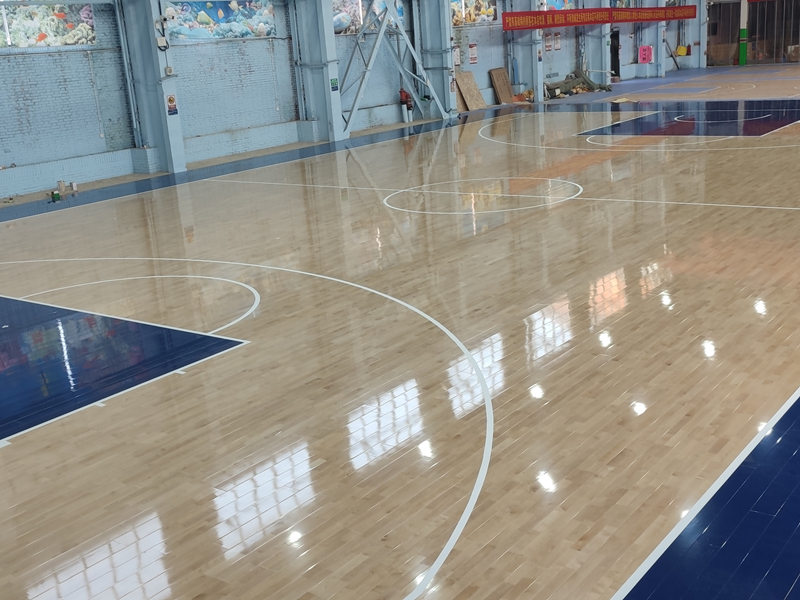
The installation of indoor basketball court wood flooring is a highly specialized process that follows strict, detailed standards to ensure the final floor meets all performance and safety requirements. The work always starts with a full inspection of the concrete base of the venue. The installation team uses long straight edges to check the flatness of the entire concrete surface, marking any spots that are uneven by more than a tiny, specified measurement. These uneven areas are ground down or filled in with specialized leveling compound, because even a small bump or dip in the concrete will transfer through every layer of the floor and create a dangerous uneven spot on the playing surface. Before any materials are laid, the team also tests the moisture level of the concrete, to make sure there is no excess water trapped in the base that could seep up into the wood layers later.
Next, the subfloor layer is laid out over the prepared concrete. The planks of this layer are secured with specialized fasteners that do not go all the way through to the concrete, allowing the entire subfloor to move very slightly as the wood expands and contracts with humidity changes. This "floating" or semi-floating installation method prevents stress from building up in the floor, which would otherwise cause large sections of the wood to warp or buckle over time. After the subfloor is complete, the elastic cushioning layer is carefully positioned, with every piece aligned perfectly to ensure there are no gaps or overlaps that would create inconsistent shock absorption across the court. The cushioning layer is tested with a professional impact tester at multiple points across the entire court, to confirm that the shock absorption level meets the required standards in every single area.
Finally, the top wood playing surface is laid out. The installation team arranges the planks carefully, making sure that the joints between adjacent rows of planks are staggered, so there are no long continuous seams running across the entire width of the court. Each plank is secured with hidden fasteners that go into the edge of the wood, leaving no visible nails or screws on the top playing surface that could catch on a player’s shoe or cause injury. After all the planks are in place, the entire surface is sanded multiple times with progressively finer sandpaper, to create a perfectly smooth, flat surface across the full 94-foot length of a standard full-size court. The final step of the installation process is a full inspection, where technicians test the friction, shock absorption, and ball rebound at dozens of different points, to confirm that every part of the new floor meets the highest professional performance standards.
Leave a Reply