

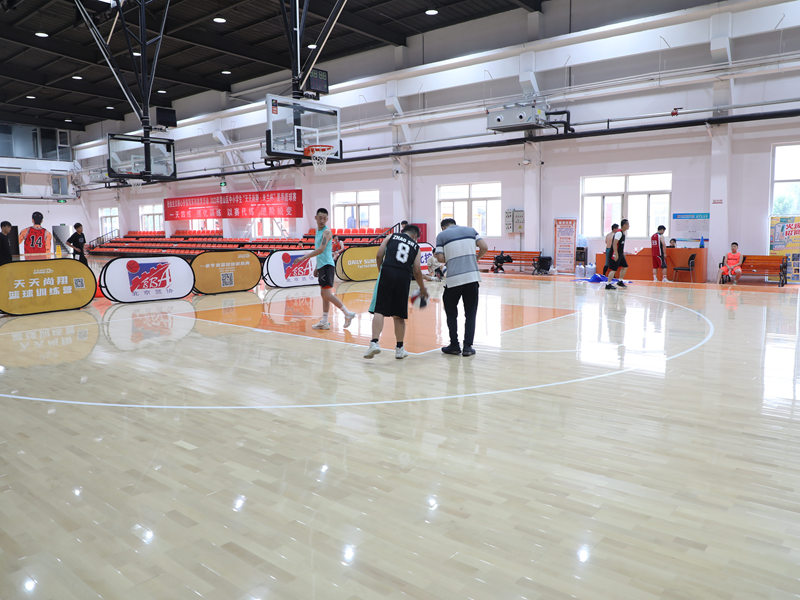
Different sports have different demands on the playing surface. A floor that's perfect for basketball may not be ideal for badminton. In this sport-by-sport guide, we explore the specific requirements, recommended flooring specifications, and best practices for indoor sports wooden flooring across a range of sports.
Basketball
Requirements:
- Ball Rebound: 90-96% (FIBA/NCAA standard)
- Shock Absorption: 35-50% (minimum 35%)
- Vertical Deformation: 0.6-2.3mm
- Traction: High (to prevent slipping during quick cuts)
Recommended Flooring:
- Species: Maple (Select or #1 Common)
- Thickness: 20-22mm solid or 14-15mm engineered
- Finish: Matte (10-30 gloss units) for maximum traction
- Installation: Nail-down (solid) or glue-down (engineered)
Special Considerations:
- The three-point line and free-throw lane must be painted with sports-grade line paint.
- The floor must be absolutely flat — any variation will affect ball bounce.
- Professional NBA arenas use maple with a custom UV-cured finish.
Volleyball
Requirements:
- Ball Rebound: Similar to basketball (90%+)
- Shock Absorption: 35-50% (critical for jumping and diving)
- Surface: Must be smooth and even — no rough spots that could injure players diving for the ball
Recommended Flooring:
- Species: Maple or Oak
- Thickness: 18-20mm solid or 14-18mm engineered
- Finish: Matte or semi-gloss
- Installation: Nail-down or glue-down
Special Considerations:
- Volleyball courts require a larger surface area (60' x 30' for indoor) with a surrounding free zone of at least 10 feet.
- The net posts must be securely anchored without damaging the floor.
Badminton
Requirements:
- Ball Rebound: Less critical (shuttlecock doesn't bounce)
- Flatness: Critical — any unevenness will affect shuttlecock trajectory
- Shock Absorption: 20-35% (moderate)
- Traction: Medium (players slide and lunge frequently)
Recommended Flooring:
- Species: Maple or Beech
- Thickness: 14-18mm engineered (lighter weight is sufficient)
- Finish: Semi-gloss or gloss (smoother surface helps shuttlecock glide)
- Installation: Floating or glue-down
Special Considerations:
- Badminton courts are smaller (44' x 20' for doubles), so the floor doesn't need to be as thick as basketball courts.
- A PVC synthetic floor is also popular for badminton due to its smooth, consistent surface.
Handball
Requirements:
- Ball Rebound: 85-95%
- Shock Absorption: 35-50% (players are constantly jumping and landing)
- Traction: Very high (players make quick directional changes)
Recommended Flooring:
- Species: Oak (preferred in Europe) or Maple
- Thickness: 20-22mm solid
- Finish: Matte
- Installation: Nail-down
Special Considerations:
- Handball is primarily played in Europe, where oak is the dominant species.
- The court size (131' x 66') requires a large, uninterrupted surface.
Futsal (Indoor Soccer)
Requirements:
- Ball Rebound: 85-95%
- Shock Absorption: 30-45%
- Traction: High (players wear indoor soccer shoes with rubber soles)
- Surface: Must be rough surfaces can damage the ball
Recommended Flooring:
- Species: Maple or Beech
- Thickness: 14-18mm engineered
- Finish: Matte or semi-gloss
- Installation: Glue-down or floating
Special Considerations:
- Futsal is often played on multi-purpose floors, so a versatile engineered system is ideal.
- The smaller ball (Size 4) requires a smoother surface than a basketball.
Gymnastics
Requirements:
- Shock Absorption: 40-50% (critical for landing from vaults and tumbling)
- Firmness: The floor must be firm enough to provide a stable landing surface
- Flatness: Extremely critical — any unevenness can cause injuries
Recommended Flooring:
- Species: Maple or Beech
- Thickness: 18-20mm solid with foam underlayment
- Finish: Matte
- Installation: Nail-down with foam underlayment
Special Considerations:
- Gymnastics floors often require a spring floor system (wood over foam pads) for maximum shock absorption.
- The FIG (International Gymnastics Federation) has specific performance standards.
Tennis (Indoor)
Requirements:
- Ball Rebound: 85-95%
- Shock Absorption: 30-40%
- Surface: Must be extremely smooth and even
Recommended Flooring:
- Species: Maple or Beech
- Thickness: 14-18mm engineered
- Finish: Semi-gloss or gloss
- Installation: Glue-down or floating
Special Considerations:
- Indoor tennis is less common than outdoor, but when played indoors, a smooth, even surface is essential.
- Many indoor tennis facilities use synthetic surfaces, but hardwood is also used at the professional level.
Multi-Purpose Facilities
Requirements:
- Must accommodate multiple sports with different performance needs
- Durability is paramount (high traffic from different activities)
- Versatility in markings and configuration
Recommended Flooring:
- Species: Maple or Oak
- Thickness: 18-22mm solid or 14-18mm engineered
- Finish: Semi-gloss (good all-around traction)
- Installation: Nail-down (solid) or glue-down (engineered)
Special Considerations:
- Use removable line systems (tape or paint) to quickly reconfigure the court for different sports.
- A semi-gloss finish provides a good balance of traction for basketball and smoothness for badminton.
Summary Table
| Sport | Best Species | Thickness | Finish | Key Requirement |
|---|---|---|---|---|
| Basketball | Maple | 20-22mm solid | Matte | Ball rebound, traction |
| Volleyball | Maple/Oak | 18-20mm solid | Matte | Shock absorption |
| Badminton | Maple/Beech | 14-18mm eng. | Semi-gloss | Flatness |
| Handball | Oak/Maple | 20-22mm solid | Matte | Traction, shock absorption |
| Futsal | Maple/Beech | 14-18mm eng. | Matte | Smooth surface |
| Gymnastics | Maple/Beech | 18-20mm + foam | Matte | Shock absorption |
| Tennis | Maple/Beech | 14-18mm eng. | Semi-gloss | Flatness |
Conclusion
Choosing the right indoor sports wooden flooring for your specific sport is essential for optimal performance and athlete safety. By understanding the unique requirements of each sport, you can select a flooring system that delivers the best possible playing experience.
Leave a Reply