

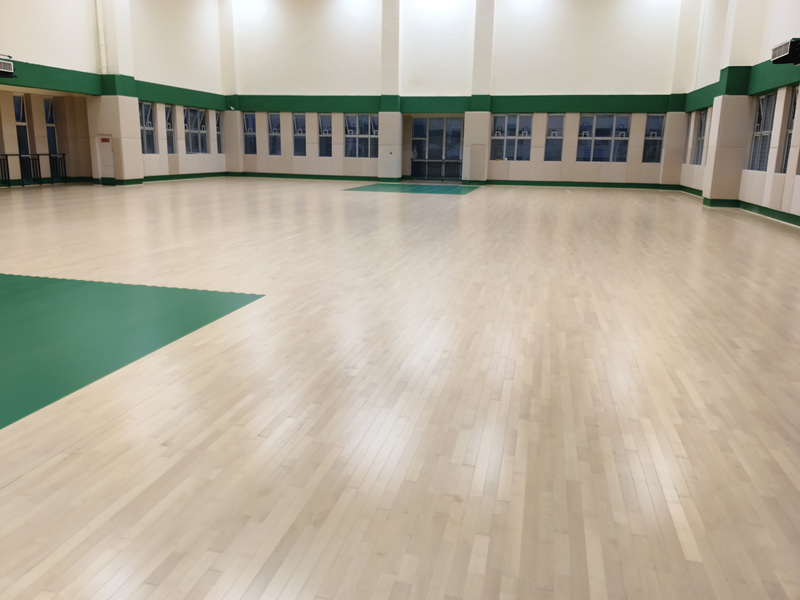
Multi-purpose gymnasiums are among the most challenging environments for sports flooring. A single space might host basketball, volleyball, badminton, fitness classes, school assemblies, and community events — all in the same week. The flooring must perform well for every one of these uses, which creates a unique set of requirements.
The first challenge is versatility. Different sports have different performance requirements. Basketball needs high shock absorption and a specific friction range. Volleyball needs even higher shock absorption for diving. Badminton needs precise traction control. A floor that is optimized for one sport may not be ideal for another. The solution is a tunable subfloor system. By adjusting the thickness and density of the shock pads problems before they become serious, and even provide performance analytics to coaches. Smart flooring is already being used in some professional arenas, and it will become standard within five years.
The second trend is sustainability innovation. Manufacturers are developing new finish coatings that are entirely water-based and free of any petrochemical components. Engineered wood products are becoming more efficient, with less waste and lower energy consumption in manufacturing. Some companies are experimenting with bio-based adhesives and coatings that further reduce the environmental footprint. The goal is a fully circular product — one that can be sourced, used, refinished, and recycled with zero waste.
The third trend is modular and reconfigurable systems. As multi-purpose facilities become more common, the demand for floors that can be quickly reconfigured for different sports is growing. New modular subfloor systems allow facility managers to change the shock absorption and friction characteristics of the floor in hours, not days. This makes it possible to transform a basketball court into a volleyball court — or a fitness space — with minimal downtime.
The fourth trend is enhanced finish technology. New nano-coatings and ceramic-infused finishes are offering better durability, more precise traction control, and improved resistance to scratches and stains. These finishes last longer between recoatings, reducing maintenance costs and downtime.
The fifth trend is data-driven design. Computational modeling and artificial intelligence are being used to design subfloor systems that are optimized for specific sports, specific usage levels, and specific building conditions. Instead of using a generic system, facilities can now specify a floor that is custom-engineered for their exact needs.
The sixth trend is health and wellness integration. As the focus on athlete wellness grows, flooring is being designed not just for performance but for recovery. Some new subfloor systems are being engineered to provide therapeutic benefits — reduced joint stress, improved circulation, and faster recovery times.
Indoor sports wood flooring has come a long way from simple planks on a gymnasium floor. The future is bright, and it is built on the same foundation that has always driven this industry: the relentless pursuit of a better playing surface.
Leave a Reply