

Uniform ball bounce is one of the most important performance indicators of a high-quality indoor basketball wooden floor, and it is a result that can only be achieved through precise and careful assembly. When a basketball bounces on the court, the height and direction of the bounce must be exactly the same no matter where the ball lands, so that players can accurately predict how the ball will react and make the right moves. If some areas of the floor make the ball bounce higher than others, or if the bounce is inconsistent, it will seriously disrupt the players’ rhythm and even affect the fairness of the game. To achieve this perfect uniform bounce, every step of the assembly process must be done with extreme precision.
The foundation of uniform ball bounce is a perfectly level subbase and a consistently installed support structure. During assembly, the sleepers that form the support system must be placed at exactly the same spacing across the entire court, and every elastic pad under the sleepers must be of the same thickness and elasticity. If one sleeper is placed slightly higher than another, or if one elastic pad is compressed more than the others, the corresponding area of the floor will be harder or softer than the rest, leading to a different ball bounce height. Professional installers will use a laser level to check the height of every part of the support structure, making tiny adjustments with thin shims whenever necessary to ensure that the entire support network is completely level.
After the top wooden planks are laid, the sanding process is another critical step to ensure uniform ball bounce. The entire surface of the basketball wooden floor must be sanded multiple times with progressively finer sandpaper, removing all small uneven spots, scratches, and raised edges. This creates a perfectly smooth and consistent surface across the entire court. After sanding, the finish applied to the floor must also be spread evenly, with the same thickness on every part of the surface. Once the assembly is fully completed, workers will conduct ball bounce tests at hundreds of different points across the court, dropping a standard basketball from a fixed height and measuring the rebound height at each point. Only when all the test results fall within the allowed standard range can the newly assembled basketball wooden floor be considered qualified for competitive play.
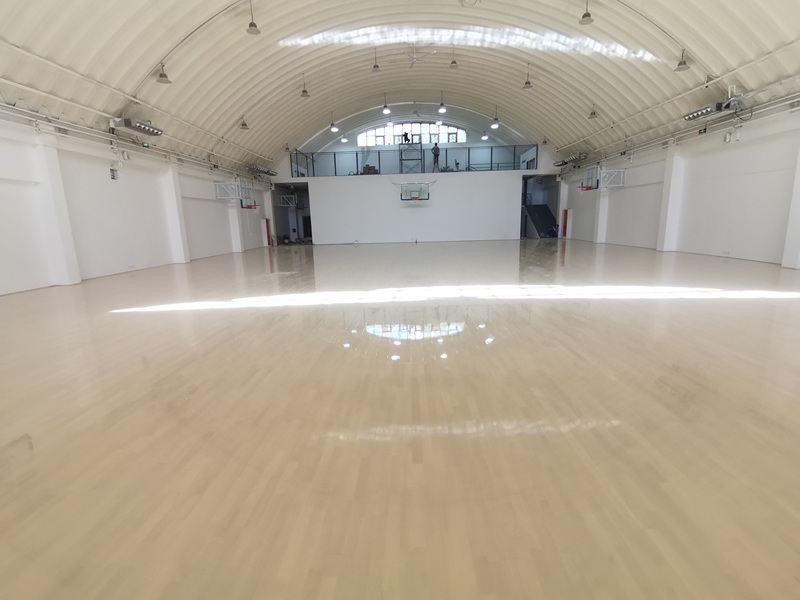
How to Ensure Uniform Ball Bounce Across Your Newly Assembled Indoor Basketball Wooden Floor
Leave a Reply